By Grace Atkinson
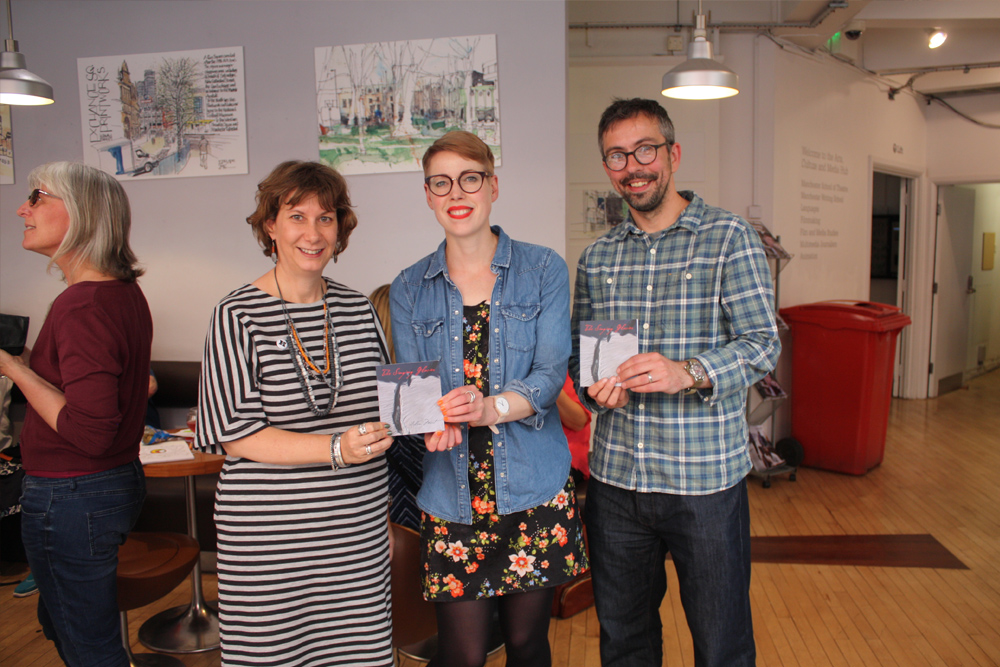
Award-winning poet Helen Mort, launched her new pamphlet The Singing Glacier this week, with a night of poetry and performance held at Manchester Metropolitan University. The event, hosted by the Manchester Writing School, was part of the Writers at Manchester Met series.
Helen Mort is a lecturer of Creative Writing at Manchester Metropolitan, as well as a poet, novelist, and playwright. She is a five-times winner of the Foyle Young Poets award, and won the Manchester Poetry Prize Young Writer Prize in 2008. She has two poetry collections with Chatto and Windus, Division Street (2013), which was shortlisted for the T.S Eliot Prize, and No Map Could Show Them (2016). Her novel Black Car Burning is forthcoming.
In August 2016, funded by the Little Baroque Company, Mort, along with composer William Carslake and filmmaker Richard Jones, travelled to climb the glaciers of east Greenland. Collecting footage, sounds and inspiration from their journey, the three collaborated to make an orchestral performance, set to violin and piano, and including silent film and mort’s poetry sequence. The Singing Glacier is a written record of that performance.
The book is made up of poetry from Mort, a conversation between Mort and Carslake as well as excerpts of the score from his musical response to their travels, drawings from artist Emma Stibbon and a critical essay, written by David Cooper.
The evening was introduced by Senior Lecturer in English at Manchester Metropolitan Dr David Cooper. He said, “Over the past few years at Manchester Met there has been an increasing emphasis on the relationship between writing and place, and that’s been manifested in a number of ways, partly through our teaching, through undergraduate courses, through MA pathways. It has also been manifested in a number of PhD students that we’ve got in the department, which has been this growing body of PhD students working on the relationship between creative practice, critical thinking, and landscape and environment. The pamphlet that we are launching tonight is a part of that commitment to the relationship between writing and place.
He continued, “I think at the centre of this books is a commitment to collaboration and a lot of what we do at Manchester met in terms of this emphasis on place writing is to celebrate collaboration, so bringing writers together within the Manchester Writing School.”
Next to take the stage was Tamar Yoseloff, Editor at Hercules Editions, an independent press combining poetry and prose with art and archival material.
Yoseleff recalled first seeing the performance in November, saying: “It was Helen’s poem that stayed with me, and I remember thinking at the time that it was a shame that the text wasn’t available, because I felt that I really wanted to be able to sit down and read it on my own in silence and just enjoy the words. So I was absolutely thrilled when Helen got in touch with me a few months later and asked if I would you be interested in publishing the text”.
Mort then went on to give some insight into the experience of her three-week journey, commenting: “I learnt a lot of things while I was there, I learnt how to set traps for polar bears, to deter them so that if they bumped into the wire they would get a shock of light and back off, I also learnt that six-foot composers can set off those wires quite easily as well. I leant that Ukrainian fishermen like to drink stove fluid sometimes to keep warm. Most of all I learnt what its like to live beside this ever -changing, constantly surprising glacial landscape”.
A clip was the screened, where Mort’s voice recited the first poem in the sequence, ‘Glacier Song’, punctuated with Carslake’s beautiful score, set to an orchestra of strings and piano. At times, the music acted as a response to the call of Mort’s words, at others causing a tension and chaos to fill the poem. Meanwhile, Richard Jones’ silent film showed on screen, where huge, open skies in pink and orange beamed over cascading ice, while birds, whales and the travellers themselves balanced below. The result of the collaboration was hauntingly still and incredibly beautiful.
Next Helen read other poems from the pamphlet. ‘And Noah’, a found poem made from the words of a local man, built a narrative of the resourcefulness of the landscape’s people and also the effects global warming is having on it’s inhabitants: “Everything is useful/ in some way. Here/ is Noah’s Kayak, made by our son. / Twenty years ago, / there were no mosquitoes/here.” “The Glacier Speaks’ attempts to encapsulate the silent voice of the glacier: ‘Go on then/ says the glacier – / how are you going to score my silences?”.
These were as much place poems, as they were environmental poems, and pivoted perfectly between stunning and transparent visuals, and a terrifying warning of humanity’s destruction on the landscape.
Speaking to aAh! as the evening drew to a close, Manager of the Manchester Writing School James Draper, said: “What great event and a fantastic performance by Helen and also a really good example of both the quality of the poetry being produced by the Manchester Writing School but also, as David said, our leading expertise in place writing, particularly creative practice, and what a relief on such a hot, hot day, to have an event that focused primarily on ice.”
You can watch a clip of the film on Vimeo, using the following password: Kulusuk



Leave a reply