Have you experienced any coughing fits recently? How about itchy eyes or an irritated nose? It might not just be hay fever. According to Clean Air Greater Manchester (GM), these can also be the effects of toxic air pollution — one of the biggest health risks in the city today. More worryingly, air pollution can exacerbate asthma and cause strokes, heart disease and cancer in the long term.
Air pollution usually consists of one of two main types — nitrogen oxide (NO2), a gas produced when fuel is burned, or particulate matter (PM10 or PM2.5), a mixture of particles from things like dust, metal, smoke and waste. Both types are harmful; major causes of early death in and around the country.
According to a report by the Institute for Public Policy Research (IPPR), Manchester’s level of air pollution is “lethal and illegal” and will wipe an estimated 1.6 million years off collective life spans in the city over the next century. Air pollution already contributes towards around 1,200 deaths in Manchester each year, with the city having the “highest rates of emergency admissions to hospital for asthma” across the UK.
London is far ahead of Manchester in tackling air pollution.
A study by the World Health Organisation in 2018 found that Greater Manchester County Council was the 2nd worst for air pollution in the country, exceeding ‘safe limits’, whilst London was 22nd on the list. 37% of London’s buses are electric or meet Euro 6 emission standards*, yet in Manchester, this figure is only at 10%.
*Most air quality standards in Britain are decided by the EU — policies that could be greatly impacted by the Brexit process.
The problem costs Greater Manchester’s economy around £1 billion per year.
Local authorities, subsequently, are attempting to cut levels of air pollution with a ‘Low Emissions Strategy’ and ‘Air Quality Action Plan’, which aim to reduce congestion and encourage environmentally friendly transport.
However, according to IPPR North, Greater Manchester still won’t be able to reduce emissions by any more than 7.5% with these plans, which are apparently neither ambitious nor efficient enough to tackle the problem.
The report concludes that Andy Burnham, Mayor of Greater Manchester, needs to “do more, much more quickly”.
Advice for Mr Burnham included building charging zones for electric vehicles, uniting with mayors from neighbouring cities to demand action from the UK Government (such as more clean air funding), and to further study the effects of air pollution on health.
Several groups and organisations have also set about trying to tame Manchester’s toxic air.
Clean Air GM is an offshoot campaign from Transport for Greater Manchester (TfGM), collaborating with local authorities around Manchester, which aims to support cleaner transport alternatives such as electric vehicles and cycle networks, reduce congestion, and introduce ‘Clean Air Zones’ across the city. Within these areas, some heavily polluting vehicles such as buses, lorries, vans and taxis would have to pay a penalty for entering.
According to Clean Air GM, the Government has “instructed [Manchester] to take quick action to reduce NO2 emissions.”
They’re hosting a ‘Clean Air Week’ until 23rd June, during which several events are taking place across the city to spread awareness of the campaign.
One such attraction is the ‘Pollution Pods’, by artist Michael Pinsky at Salford Quays which offer visitors a (non-harmful) taste for varying levels of pollution across five different cities, such as fresh air in Norway and thick smog in Singapore.
Apparently, the project aims to “challenge perceptions of, and actions around, climate change.”
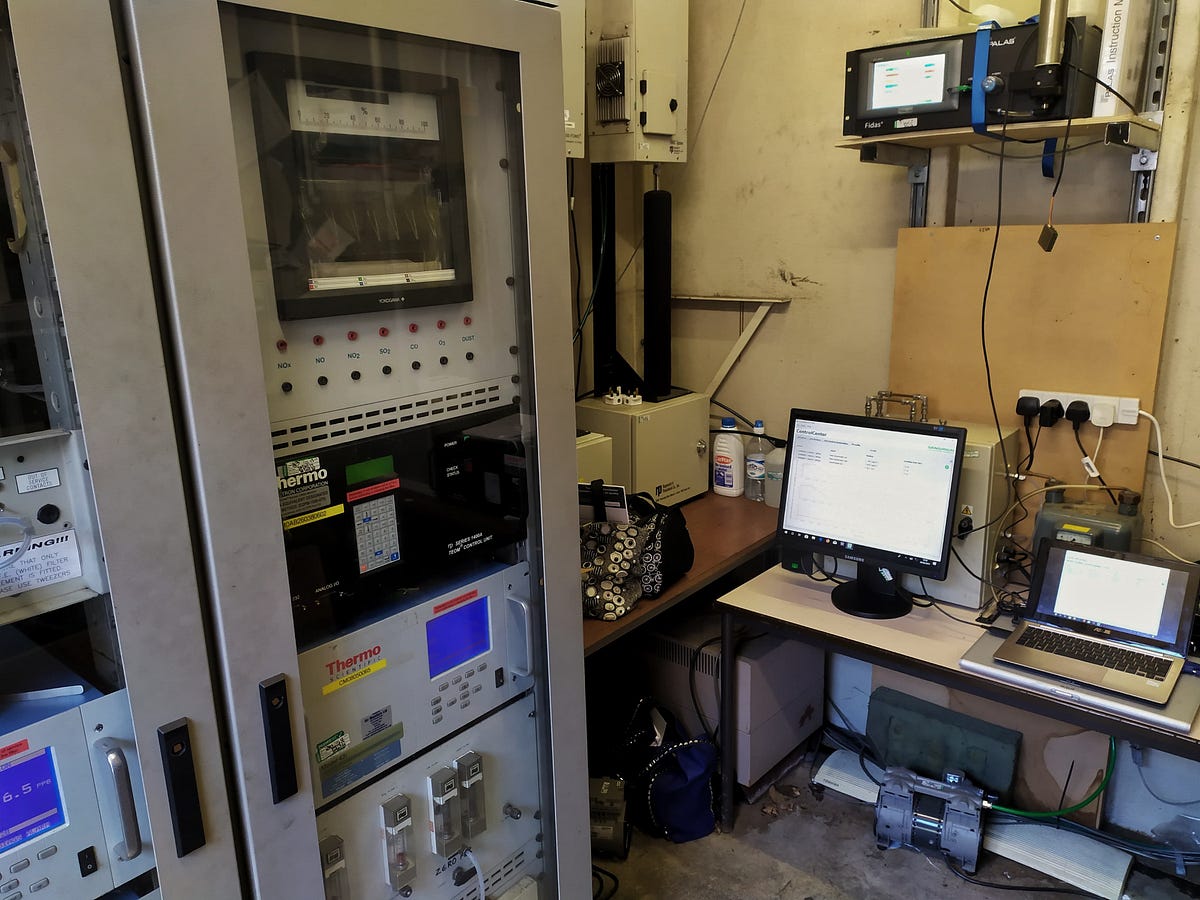
The little-heard-of air quality monitoring station at Piccadilly Gardens owned by TfGM was also opened on Thursday, offering visitors a tour of the equipment housed inside. The station measures hourly data of air quality in the Gardens, which was, however, “pretty good” on the day, according to Iain Kingston, the tour guide.
Source: Ben Townsend
Similar stations exist on Oxford Road and Manchester Sharston. Updated results from the stations can be found online.
In an attempt to address environmental concerns as a whole, a group called ‘Climate Emergency Manchester’ are petitioning for the City Council to declare a ‘climate emergency’, which, according to the campaign page, has already been declared by other councils in the UK, including the Government, but not by authorities in Greater Manchester.
The campaign also aims to make Manchester “zero carbon” by the year 2030, ahead of the council’s current ambition for 2038.
“Declaring a climate emergency” and relevant action will “show true leadership on the crucial issue facing young people today,” the group says.
Marc Hudson, co-founder of the movement, spoke to aAh! Magazine and said that they’re “about halfway to [their] 4000 target” for signatures.
Manchester City Council are inviting members of the public to join the Manchester Climate Change Conference 2019, taking place on 8th July at the University of Manchester. The meeting will discuss how well the city has tackled climate change in the past year, and what can be done to make Manchester zero carbon in the future. Entrance is free.
There’s also a lot that the public can do to reduce and avoid air pollution on a daily basis:
1. Walk, cycle, catch public transport or car share
2. Avoid busy roads and slow-moving traffic
3. Travel outside peak times
4. Open windows and turn on extractor fans to remove smoke whilst cooking
What do you do to reduce and avoid air pollution? Let us know in the comments.
Featured image and gallery: Hoang Phan Notebooks were carried from one workshop to another. Writers from different generations sat around tables, sharing manuscripts and listening to each other. Outdoors, small groups strolled along Oxford Road, pausing before buildings steeped in literary history. This was the scene during the Manchester Writing School Summer Festival 2026, held…
Featured image: Katja Ogrin With many sore heads and limbs this morning after the most hardcore day of the festival taking place yesterday, many are recovering from the moshing and pit brutality of the previous day’s antics. As the tradition of a morning movie in the Serpents Lair prevails, the crowd sprawls out onto the plush,…
Featured image: Abbi Draper After an electrifying start to the weekend, with temperatures slowly climbing, many lather themselves in suncream, shed their band shirts and rise from their tents to trek towards the arena. Saturday has big things incoming for the humans of Bloodstock 2026. Some pace themselves for the day and hide from the early…
Featured image: Abbi Draper After a memorable Thursday opener, Bloodstock 2026 opens its gates once again onto the Hallowed Grounds of Catton Park, kicking off day two of its 25th-anniversary celebration of metal. As the sun rises on Catton Park, festivalgoers emerge from their tents to prepare for another day of mayhem. The morning brings…




Leave a reply