You are here:Home / Features / News / ‘The cost of living crisis is killing creativity’: Students are battling rising costs to heat their homes and make the most out of university
Every morning Isobel wakes up “absolutely freezing”. Shivering while she sleeps, even with three or four blankets over her, she still wakes up cold. With her university clothes laid out on her bed, she begins to get ready for her day. Boiling the kettle, she places her hands on the hot surface in an effort to warm up. Stepping out into the bitter air Isobel walks to uni, opting to keep warm by walking and saving on travel costs by not taking the bus. This is the reality for many students during this cost of living crisis.
Across the country, students are battling rising costs to heat their homes, which is affecting their ability to work creatively. According to the Office for National Statistics, 50% of students feel like they have financial struggles, with 15% describing these as ‘major financial difficulties’.
“A lot of students are staying in university longer just to keep warm,” says Isobel, an MA Graphic Design student.
With student loans no longer covering living costs, more and more students are finding it hard to balance university and part-time jobs in an effort to support themselves, and are spending longer on campus to avoid having to put their own heating on.
A survey conducted by the student accommodation group Unite Students found that almost half (49%) of students are working part-time to support themselves at university. Among those, 64% work seven hours or more per week and more than half are concerned about the impact that a part-time job has on their studies.
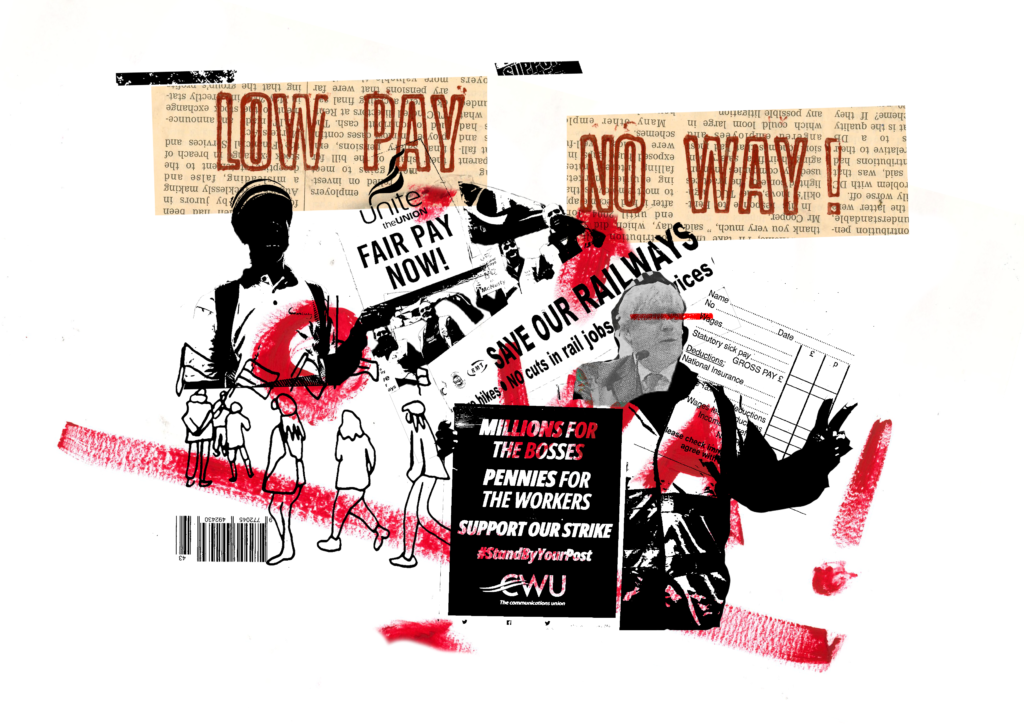
Mixed media: Macy Evans
For Performing Arts student Fin, it’s a struggle to balance work and university life, particularly as he travels home for work. “It’s more convenient for me to travel home from university to work because it’s more flexible than a job in Manchester,” he says. “I’m finding myself going home more as I am actively working to earn money.”
Some students are faced with the difficult choice of whether to miss university seminars and lectures as they simply cannot afford to live unless they work. This is a vicious circle that is on Fin’s mind a lot. He has a job so he’s earning, but it’s at home so he’s away from university, and missing classes. He feels that he’s falling behind with his studies – which he probably is – but he needs that money to be able to afford to live in Manchester.
“It’s affecting my work ethic and degree course,” he says. “I’m too worried about money to fully focus on the degree itself.”
Budgeting as a student can be difficult, particularly during a period of rising inflation, energy bills and other costs. A survey by the National Union of Students says 32% of students are not confident their student loans will cover the cost of essential educational materials such as books and specialist software.
As a graphic design student, Isobel is conscious of the costs related to her course which include printing and other materials. She is concerned about how this will affect her overall performance in her degree, and the worry about budgeting is holding her back creatively.
“I would love to be really experimental and produce loads of sheets and different types of work looking for various outcomes but I think: ‘Oh my God, I can’t do that because it will be such a waste of money,” she says.
“The other day I was screen printing and when I had finished everything, I checked the work and realised I had made a spelling mistake. And that’s £2 for screen printing and 80p worth of paper down the drain!”
Isobel says many students are becoming increasingly anxious about making errors and wasting material because of the high costs of producing artwork, which only results in further blunders.
“It doesn’t sound like a lot at that moment, but if you are making small changes or mistakes over and over again it builds up.”
Filmmaking student Lui is paying for actors and buying props to complete his assignments and it’s costing him more than expected. Lui says there is no additional support for students on his course to fund their projects and no promise of when they will make these costs back.
With his goal being to submit his film to a festival, Lui pays his actors a daily rate, or as a minimum, covers their travel costs. Lui is well-motivated and wants to succeed, but feels his work may not be as good as it could be as he is going to have to cut back on props and sought-after actors.
Many students have felt a strain on their mental health since coming to university. This is certainly the case for Fin. “I am more conscious of money and spending because everything adds up making me feel more stressed about my financial situation,” he says.
Isobel has also felt increasingly worried due to the cost of living crisis: “Looking back from when I started university, I could go out whenever I wanted to and money was never an issue,” she says. “You could enjoy yourself, treat yourself and not have to worry too much about money. Nowadays everything is tighter, everything is more expensive.”
Mixed media: Macy Evans
The mental health charity Manchester Mind has seen a 40% increase in the number of people contacting their information line about difficulties with financial matters such as welfare, unemployment, and personal debt.
“Poor mental health can make earning and managing money harder and worrying about money can make your mental health worse. It can start to feel like a vicious cycle,” says Sam Harwood, Manchester Mind’s communications manager.
Manchester Met has set up a new student hub to offer advice and helpful links to students and has ‘significantly increased’ the Student Hardship Fund. The information covers ways to manage budgets, save money, seek help for health and wellbeing, find a part-time job through Jobs4Students or apply for financial support, while the Student Hardship Fund covers day-to-day support, bridging loans, bursaries, support with accommodation fees and help for estranged or disabled students.
The hub includes guidance on how students can apply for hardship support, and warns them not to wait until they are running out of money before they do. The university explains its Day-to-Day Support payments ranging from £100 – £3,000 are limited and that ‘students only ever receive the maximum support in very exceptional circumstances.’ They also state at least a third of applications for hardship support may be rejected.
Despite the latest pressures of the cost-of-living crisis, creative students like Isobel are trying to remain positive: “I do go out and enjoy myself every now and again, because it is important to enjoy yourself in life. But when I spend, I only buy the basic things, and it is really hard to have anything left to put money into your craft.”
Manchester Met’s Student Hub is on hand to give advice to students about the cost-of-living crisis. The Student Hub is accessible 8:45am to 4:30pm, Monday to Friday in the Business School building or via phone on 0161 247 1000.
First published in The ENERGY Issue. Pick up your copy on campus or read online.
Featured image: Georgina Hurdsfield After the considerably grey weather of the weekend, Sunday morning started with a spell of glorious sunshine to wake the people of Leeds Festival, a spot of cheer going into the dreaded final day of the weekend. But, of course, it wouldn’t be a proper festival weekend without the flash downpours,…
Featured image: Henry Redcliffe Not to be outshined by the artists performing today, the rain makes its inevitable return to the skies of Yorkshire over Leeds Festival. With the downpours hardly taking a break, Saturday is the day for the indie-heads and brats, as two of the most anticipated acts of the weekend take the…
Featured image: Georgina Hurdsfield Despite the dreary weather forecast, it seems the explosive noise of the night before has blown away the expected torrential rain, as the sun fights through the clouds to shine over Leeds Festival on Friday. With the opening of the ‘other’ stages, the first double headliner, and a very special birthday,…
Featured image: Ruby Boland As the gates of Bramham Park finally opened for the 2026 edition, so too did the heavens, with heavy rain and thunderstorms forecast for the whole weekend, you’d be forgiven for thinking this year’s instalment of Leeds Festival was a write-off. Neither the punters nor the artists would let this dreary…








Leave a reply