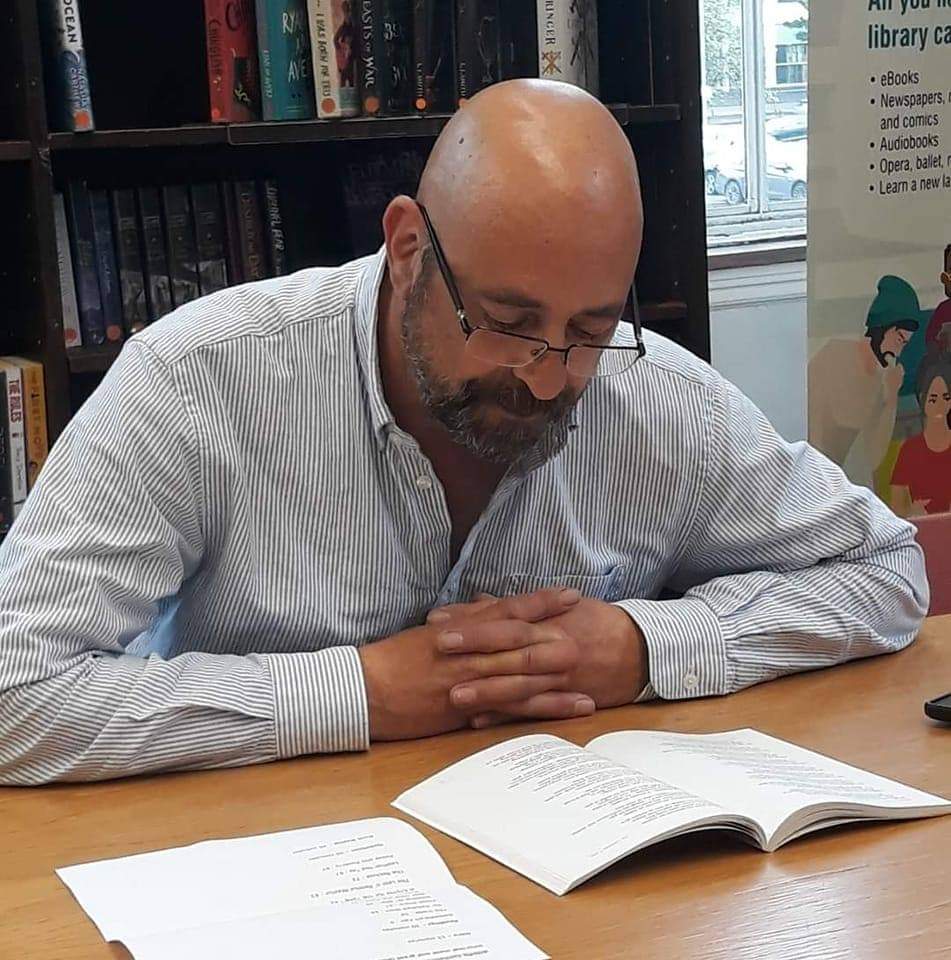
Featured image: Simon Rennie
Our new Graduate Stories series uncovers the diverse experiences of Manchester Met alumni, exploring the reality of life after graduation and highlighting career achievements. We shed light on the different paths graduates take, share relatable and honest advice, and provide practical tips for students who may feel uncertain about their next steps.
Simon Rennie graduated from Manchester Met in 2009 with an English degree. Since then, he has completed a Masters in Poetry Studies, achieved a PhD in English Literature, and is now an Associate Professor at the University of Exeter.
As a Mancunian, Simon is interested in the Lancashire Cotton Famine and the Victorian era, driven by his passion for amplifying working-class voices. He has a specific interest in working-class and politically engaged poetry of the mid-nineteenth century. He has also published three volumes of original poetry, Little Machines (2009), Unless Otherwise Stated (2011), and Adverse Camber (2019).
Simon talks candidly about how his life changed after graduating from Manchester Met and reveals why he thinks working hard, being organised, and getting experience in the real world are the keys to success.
Can you tell us about your experience applying for university as a mature student?
I failed my A-Levels twice. I was very aimless and glad that I didn’t do a degree when I was 18. Getting a degree doesn’t always happen between the ages of 18 and 21. It was amazing to do an English degree, having done 25 years of reading beforehand.
You’re not just learning about literature but the context of such literature – it changed the way that I saw the world. It was wonderful to do that at age 39. It gave me a much more balanced way of looking at the world. I’ll be forever grateful for that.
Tell us about your work exploring the Lancashire Cotton Famine.
My former partner was listening to Radio 4’s ‘In Our Time’ about the Lancashire Cotton Famine and somebody on the programme happened to mention that there was poetry written about it. I went to Burnley Central Library and found about 20 poems on the Lancashire Cotton Famine, many of them by a poet called Williffe Cunliam – that’s his pseudonym anyway. I collected 54 poems of his and edited them into a collection.
That’s when I developed the concept of Cotton Famine poetry. I took that to interviews at universities, was hired at Exeter and was lucky enough to get funding to recreate the database which has now established Cotton Famine poetry as a sub-genre.
What are some of your career highlights so far?
A highlight suggests one moment and there are so many different moments, I love my job. What still happens is that someone will thank me for the work I’ve done on Cotton Famine poetry. I got an email from a professor at Boston College saying that my database had gone down. I only found out they were using my research because it went down.
I suppose a buzzword in academia is ‘impact’. That’s what I’m proudest of, that my work changes the way that people outside of the university world think about periods of working-class history.
Do you have any advice for final year students?
Have ambition and keep an open mind. Having an English or humanities degree allows you to specialise, but you don’t have to. Look at all the successful people in this country who’ve got English degrees. That’s what you can do, any of these things, including being the Prime Minister!





Leave a reply