By Sumayyah Mussa
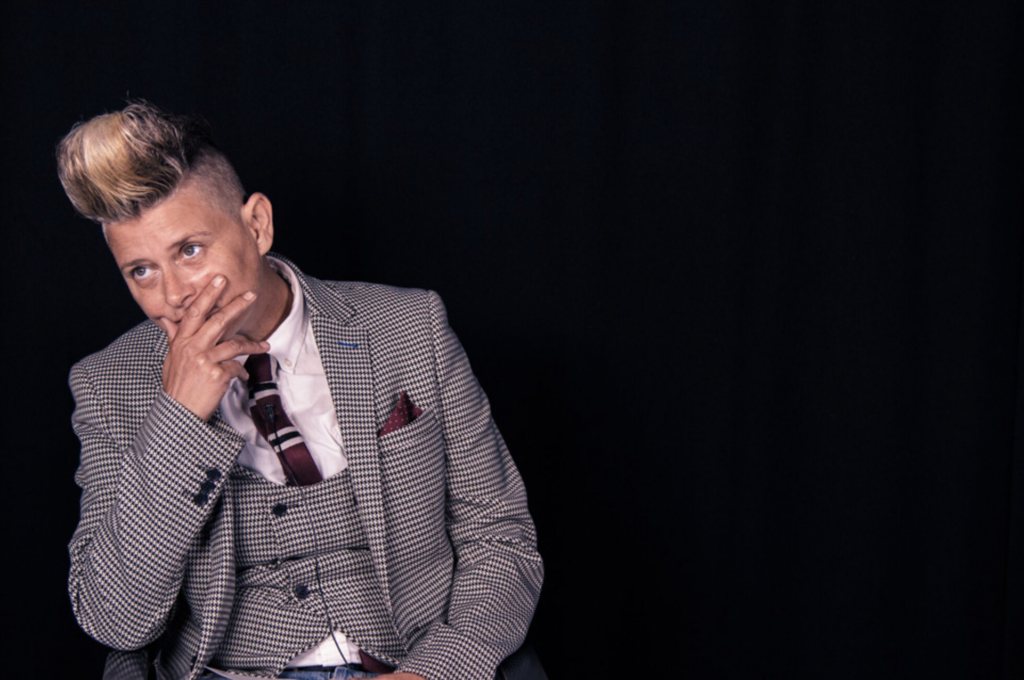
Featured image: Joelle Taylor
Award-winning poet and activist Joelle Taylor will take centre stage at Manchester Metropolitan University on Friday, as part of the 16 Days of Activism Against Gender-Based Violence campaign. Taylor will deliver a reading from their latest book, The Night Alphabet, a searing exploration of violence, trauma and identity that draws from personal experiences and the lives of marginalised women worldwide.
“My last few books, particularly, C+nto and The Night Alphabet have been focused on women’s experiences,” says Taylor, emphasising the power of poetry as a tool for activism and social change. “Within these books I talk about gender-based violence, particularly against butch women, muscular-presenting lesbians, but more generally about women worldwide.”
Taylor believes that there are strong intersections between creative writing and politics, speaking about how poetry has the ability to reach audiences or inspire change in ways that other forms of activism might not. “At the core of a poem is politics. It holds the heart of the movement of the core of each poem.
“Back in the romantic period, poems were politics. They were using their poems in order to sort of galvanise and sway and persuade and give fire to whole movements. Poetry has the ability to do that, to encapsulate. Difficult messages in very simple wording to create metaphors can make it easier for us to access quite difficult subject matters,” she says.
Highlighting how their journey as a poet and activist has shaped addressing issues like gender-based violence, Taylor believes that her different paths are an integral part of her identity and have shaped her as a person: “Myself as a writer and an artist, and myself as an activist and myself as a human are all inseparable. They are the same thing. I’m an artist, so it’s absolutely my writing that has shaped the way I live, the things I believe have shaped the way I write. It’s all interdependent,” she says.
Reflecting on the biggest cultural and systemic barriers to addressing gender-based violence today, Taylor says: “The greatest act of violence is the silencing of people.” She adds: “The silence of people happens in very middle-class ways, and very brutal ways as well.”
Drawing on personal experience, Taylor points out the need for opportunities and platforms for women to speak out about their stories and the consequences that silencing victims can have. “This really, really caused me a great deal of damage,” she explains, reflecting on how the inability to control her narrative or assert ownership over her own body led to profound harm.
Taylor adds: “I think this stretches across different women’s communities and they have different challenges to face around that silencing – whether it’s coming from inside them, the wider community, or it’s family-based. They’re so scared of women’s words.”
Taylor’s inspiration for her debut novel The Night Alphabet came from first-hand experiences and a drive to give a voice to marginalised women worldwide. Upon the success of her previous book Songs To My Enemy, which dives further into personal experiences of sexual abuse, Taylor explains that she looked further into research, archives and interviews with marginalised women. “I started making comparisons between my experience and what was happening to women globally worldwide.”
When approaching the style of the novel, Taylor aimed to challenge the traditional narrative structure and, instead, told the story in a non-linear format set across different time periods: “I wanted to be very perceptive. I wanted to write something I think of as queer futurism, which questions the idea of narrative structure anyway, and I wanted to try and find a narrative structure that we call the feminine morphology.”
Expanding on this use of unconventional narrative structure, Taylor adds: “This is really geeky, but if you think of all narrative structures based on the male morphology, that’s the male experience of physical lives. It’s the linearity of the social experience, the idea of the fact that it climbs and it mirrors the male physiological experience, which is kind of uninterrupted.”
Taylor adds that this narrative structure enabled her to incorporate multiple perspectives in the novel, further exploring themes of identity, violence, and trauma. Discussing how this contributed to the overall message of the book, Taylor explains: “I’m inside each one of them.”
Discussing her piece ‘Pipefish’, which explores the ideas behind incels, she highlights this as particularly challenging to write. “I wrote it about six years ago and I wanted to understand why certain men don’t like women. And then I wanted to feel a bit of empathy for him, because it’s so easy to make people villains, particularly these guys. So I tried to create. It that haunted me that story, because I knew I was kind of getting where he was and that he wants to protect his daughters from men like him, and this kind of strange confusion. Maybe it’s the duality that I identify with,” she says. Through such characters, Taylor encourages readers to think about the complexities of human nature and the ability to foster empathy even in the most difficult circumstances.
Reflecting on the desired impact of her work, Taylor expresses a hope that it will contribute to a broader understanding of gender-based violence: “I would hope that it’s contributed a little bit to that. And I know from going on the tour with it for the last two years that it’s had an impact in terms of women’s sense of themselves again.”
Taylor also hopes her work contributes to a greater understanding of the specific forms of violence faced by marginalised women, particularly butch lesbians. By highlighting the experiences of these individuals, Taylor aims to raise awareness and challenge societal attitudes.
Taylor’s writing has sparked conversations about sexual abuse, a topic that has historically been and still remains largely taboo. “I started writing about this back in the very early 80s and was really ostracised for writing about it,” Taylor says. Through her work on this topic, Taylor has helped to create a space for survivors to share their stories and seek support.
She hopes readers of The Night Alphabet and C+nto will too feel a sense of belonging and empowerment, reinforcing the message that poetry has the power to inspire social change: “The job of the poet is to create those words that galvanise movements.”
Join Joelle Taylor on Friday 6th November at 2pm at the Manchester Poetry Library for a reading of The Night Alphabet. Book your tickets here.
The 16 Days of Activism Against Gender-Based Violence Festival runs from 25th November to 10th December, 2024. For more information and tickets, visit mmu.ac.uk/news-and-events.





Leave a reply