Featured image: Press
Manchester Film Festival returned to Aviva Studios for its 12th edition, opening to a full house and setting the tone for an 11-day programme of screenings, premieres and industry events. The festival launched with a double-bill: Psychopomp, the directorial debut of Game of Thrones star Kit Harington, followed by Jan Komasa’s latest feature Good Boy, a psychological thriller that balances disturbing tension and off-beat humour.
Pyschopomp
A tutu-clad man stands frozen, clutching a children’s wooden block game, staring down the barrel of a gun. It’s an image suspended in a bizarre state of limbo – absurd and unsettling. Psychopomp explores the topic of suicide through a surrealist lens, following an unlikely duo as they embark on a sentimental road trip with a final destination, that purposefully leaves the audience with more questions than answers.
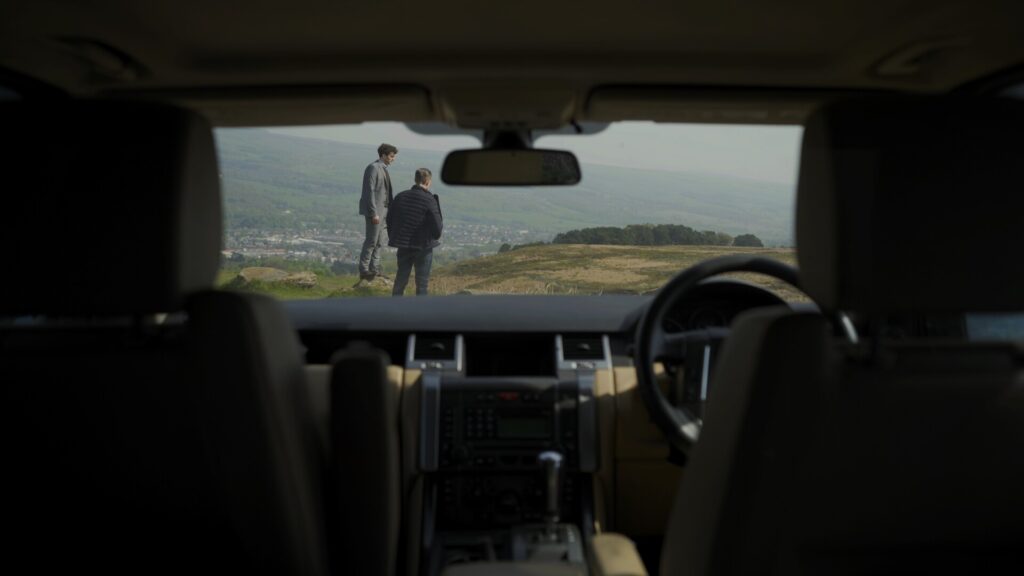
The title refers to a mythological “psychopomp” – a conductor of souls, guiding the deceased from Earth to the afterlife. Liam (played by Ciarán Owens) on first meeting is exactly that; Presenting as a remorseless grim reaper with a flash car and a very identifiable number plate; ready to guide Harry (played by Harry Meiling), a young man grappling with suicidal ideation and a vice-grip on a bygone past.
What initially presents as a bleak and fixed premise is repeatedly undercut by dry, understated humour. Liam’s blunt remarks and matter-of-fact delivery render the surreal situation strangely palatable. As the pair travel from location to location, fragments of their personalities begin to surface.
Liam, it turns out, is a man prone to the arts, recounting an inappropriate love affair with an arts teacher. When pressed by Harry, he states he “likes painting and beating people up”. This line captures the tone of this short and how even in the most bleak of situations humour can be found.
Harry’s trajectory, meanwhile, becomes increasingly deranged; comparing the company of a sex worker to a joyous memory of being with his mother as a child, and later wanting Liam to recite a poem as he ends his life.
The veil of mystery regarding the two’s journey is pulled immediately. After the opening tension, a cut to a service station café signals that this is not a mystery of what will happen, but an exploration of why. Harington’s approach shifts focus toward character history rather than plot concealment, allowing space for emotional excavation over suspense.
As the journey continues, nuggets of hope are thrown to keep the audience optimistic. The pair develop a friendly rapport, exchanging life experiences. Liam, previously mulish, in regard to their deal, even offers to take Harry home. He states that it’s too late as a letter has been left.
The mysterious complexity of Harry’s character carries this narrative to the final scene. A seemingly normal presenting young man that you would forgettably pass in the street carries a herculean amount of emotional baggage; baggage that he collects during the film and then proceeds to explain a fragment of his traumatic past.
They arrive at a vast apocalyptic-esque setting, a seemingly endless crop field with an equally endless bridge. It ends how you would expect, but the last scene is the cornerstone of this short film. It brews curiosity as the viewer aimlessly ponders, truly exploring the notion that repressed emotions in their most extreme manifestation can lead to a similar fate as this.






Leave a reply