Featured image: Evie-Iris Atkins
Grace Wales Bonner’s appointment as the new creative force behind menswear at Hermès feels less like a surprise and more like a moment of long-overdue recognition. Not only does it cement the 35-year-old designer’s position as one of the visionaries for a new era of the fashion industry, but it challenges the longstanding gender imbalance in creative industries.
“It is a dream realised to embark on this new chapter, following in a lineage of inspired craftspeople and designers,” Wales Bonner wrote on her Instagram page. It’s a fitting statement from one of the UK’s most talented designers.
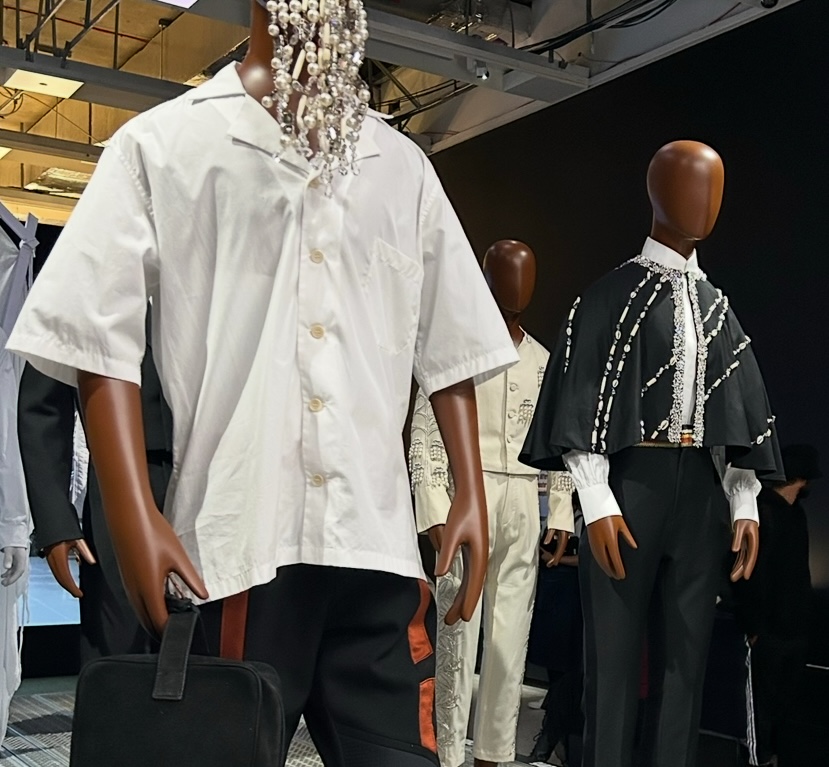
Grace Wales Bonner is a name that has not gone ignored, her work, a delicate dialogue that consistently blurs parallels between fashion and identity while powerfully nodding to tailoring as a specialty. She has an untouched aptness to redefine what modernist menswear could be through compelling narratives. The natural genesis of her brand began after her departure from Central Saint Martins in 2014. Her growing prominence in the industry has been marked by a series of accolades ever since, and with her partnership with Adidas, she has further established herself as a leading designer in contemporary fashion.
Her designs feel anthropological, hinting back to the signature style of Wales Bonner’s menswear; sensitive, intellectual, cross-cultural. For her, it has always been something beyond mere aesthetic, being a reflection of her lineage and a platform for celebrating those people that are consistently marginalised within capitalist systems.
It might seem unexpected, but the symbiotic relationship between Wales Bonner and Hermés is instinctive. From the inception of the namesake back in 2014, Wales Bonner’s collections have been nothing short of stories, told and transformed faultlessly through the thorough exploration of provocative patterns and silhouettes. Hermés, in much the same way with its desire for meticulous craftsmanship and heritage make this the perfect blend of mutual partnership. Both share a devotion to their craft and storytelling through product and brand-lineage, a sentiment echoed by Pierre-Alexis Dumas, Hermès’ General Artistic Director, who told Vogue: ‘We are at the start of an enriching mutual dialogue.’
But beyond aesthetics, her appointment matters because of what it represents. Wales Bonner is a powerhouse of creative fluency. A designer who has the power to turn raw stories into captivating artistry. And above all, is an African-British woman doing so. Fashion is chiefly stereotyped with female derivations, but in a new era of industry, men are the dominant ones.
According to 1Granary – a publication platform founded by fashion design graduates in 2013 – while undergraduate fashion courses have around 70% female enrollees, women only make up 12% of creative directors across the major fashion houses. 12%. The disparity between who studies fashion and who leads it is startling, a sobering reminder of how profoundly gendered power still remains within every industry to this day. But this imbalance is not exclusive to fashion; it is a systemic issue evident in many other fields. While cooking is often viewed traditionally as feminine, most renowned chefs are predominantly male, further solidifying how authority and creative prestige continue to be unequally distributed, even within spaces culturally coded as feminine.
In menswear, the disparity is even starker. The idea that women can lead a major menswear fashion house remains rare, almost dissonant. Wales Bonner’s presence at Hermès challenges assumptions that menswear – and indeed creative authority – belongs to men. Women should not only build foundations of co-existence in industry, but to also thrive and change the momentum of what this looks like.
For decades, male creatives have long defined ideals of femininity; from Tisci blurring Burberry’s streetwear and couture, to John Galliano modernising the defined-Dior, but Wales Bonner brings a fresh light to this spectacle. Her appointment doesn’t just signify a creative shift, but one where women are free to weave narratives of culture and community into every seam to redefine what menswear means.
In her hands, menswear becomes less about conformity, and more about the representation of uniformity. Wales Bonner embodies future creatives, one unconfined by gender, race, or geography; but shaped by authenticity. If Phoebe Philo redefined ‘quiet luxury’ for women, then Wales Bonner is poised to redefine what it means to design for men.






Leave a reply