Featured illustration: Georgia Harmey
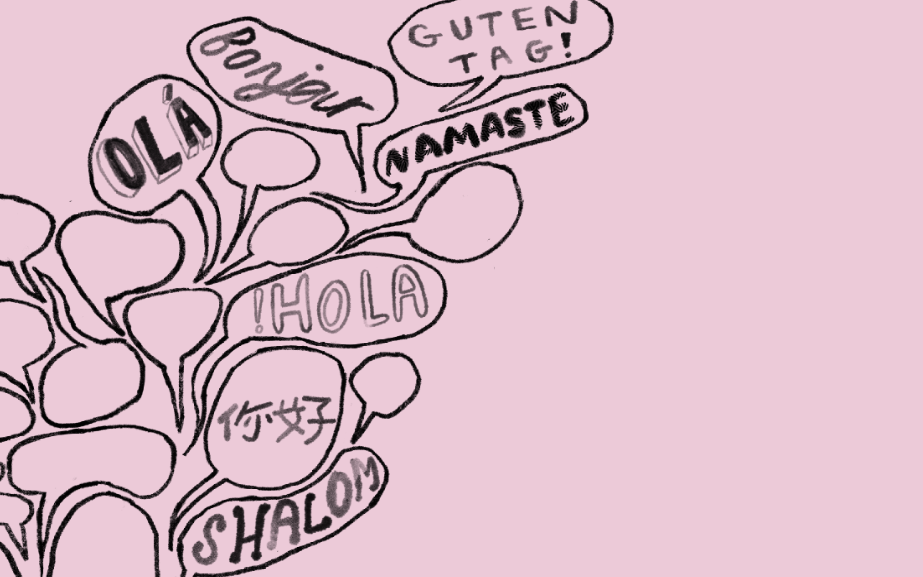
“Guten tag”, “buenos días” and “bonjour”. Many of us understand these phrases. Now, what if they were in Swahili, Russian, Mandarin or Bengali? Language learning is a vital element of our education that enhances our cognitive skills and enriches us culturally and yet, out of the 7,000 that exist, we are barely taught a handful. Broadening the linguistic spectrum of our national curriculum would not only unlock a myriad of opportunities but also aid in tackling the discrimination and hierarchy that often hides behind languages.
Throughout history, language has been used as an apparatus for social governance. Although words are used to share some of the most beautiful parts of human nature, we see linguistic oppression in the fabric of wars, genocide, colonisation and more. In the 1500s, using Arabic in Spain in any form was outlawed by King Philip II. The Goa Inquisition in India made the use of Sanskrit and Konkani a criminal offence. The teaching of sign language in many countries was prohibited as oralism was thought to be superior.
Our past has undoubtedly influenced our perception of languages in the present day, and what we associate with certain accents, ethnicities and languages are, in truth, scars from a wounded past. One of the best ways to heal from this is education.
Firstly, the introduction of new languages into the education system does not equate to the removal of current ones. German, Spanish and French, aka ‘the big three’ each play crucial roles in our relationship with Europe and the world. Moreover, the history and culture – music, science, food, cinema – of these countries is deeply intertwined with the UK. Each of these wonderful languages benefits us on a collective and individual level and must remain in the curriculum.
Nevertheless, our linguistic trends are evolving, just like our society is. The Big Three remain the most popular languages in the English school curriculum, being taught in nearly all state and independent schools. However, the number of GCSE entries for these has been fluctuating over the last few decades: 2015 was the latest peak for French and German, while Spanish has been more noticeably rising. What has surged however is the “other language” category with the number of entries in 2022 exceeding those from prior years and having the highest increase out of all categories from the preceding year.
This isn’t the only change that we’ve seen: BSL (British Sign Language) is to be added to the national curriculum for 2025 after it was legally recognised as an official language of England, Wales and Scotland two years ago.
The school curriculum should reflect the shape and character of modern society. So, how can we achieve this with languages? There are multiple ways to approach this, some more creative than others: a ‘language week or day’ could be a fun way to expose children to a wealth of countries, sounds and images that they have never before heard or considered worthy of study. We could establish a more diverse range of partner schools from across the globe, bringing with them pen pals, language videos and trips. Multilingual students, parents and staff can share their language and culture in presentations. On an official note, GCSEs and A-levels in many other languages do exist, children just often aren’t given the option to learn them; they should be implemented into the curriculum and qualifications for more languages should be created.
Through linguistic education, we can open up our perspective on the whole world and build a better relationship with it. Let’s start with the word “hello”.
What do you think? Have your say and write for aAh! Email aAh.Editor@gmail.com and follow @aAh_mag






Leave a reply