
Animal Farm @ The Manchester School of Theatre review – Orwell’s ever-relevant ‘fairy tale’ enters the 21st century with an all-female cast
By Tom Bullingham | Featured image and gallery: Lauren Naysmith
★★★★★
Animal Farm has been a mainstay on the list of all-time great stories since George Orwell first published it over 80 years ago. Yet, it remains worryingly relevant today. The story is one of the most famous allegories critiquing the ideology of socio-economic movements such as communism and totalitarianism, specifically Stalinism. The novel documents the rise of a dictatorship, from socialism, through the anthropomorphic lens of farm animals left to run Manor Farm after they’ve overthrown the humans. It tracks the unified creation of laws, which end up being discreetly altered to favour the rising powers: the pigs. The farm and animals end up in the same, if not a worse, position than they were before.
At the Manchester School of Theatre’s (MST) first play of the year, director Jimmy Fairhurst and a cast of third-year students masterfully bring this ever-present fable to the stage, performing Tatty Hennessy’s adaptation of Orwell’s original text.
Featuring a stellar, all-female cast, the production instantly casts a shadow on the patriarchy present in Orwell’s 20th century politically motivated world, bringing the cautionary tale, kicking and screaming into the 21st century. It would be interesting to know if this was an active choice from the production team, reflecting the societal expectation that women should quietly endure hardship, accept injustice and keep going in the hope that things will eventually get better, or whether it was simply a naturally occurring casting coincidence.
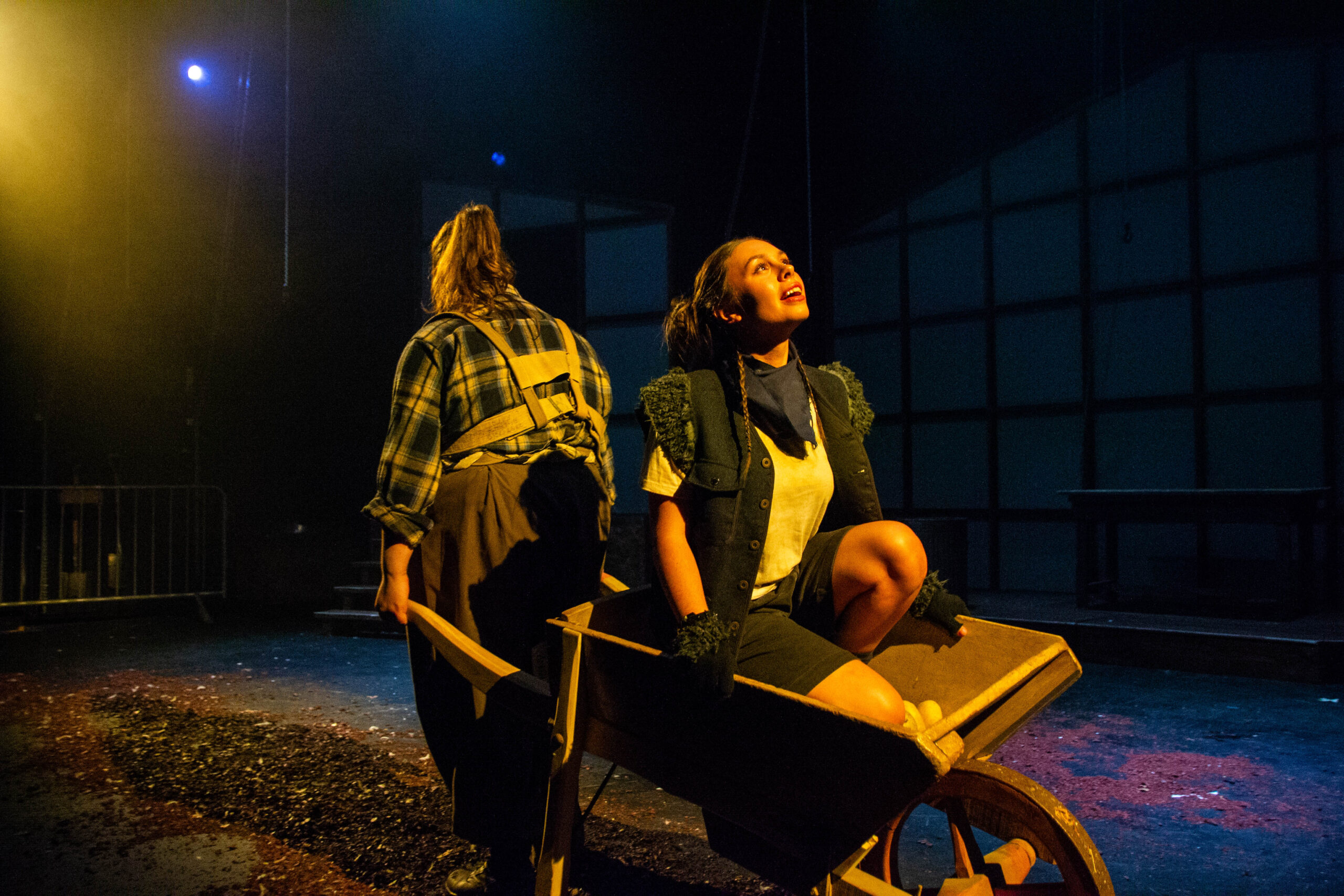
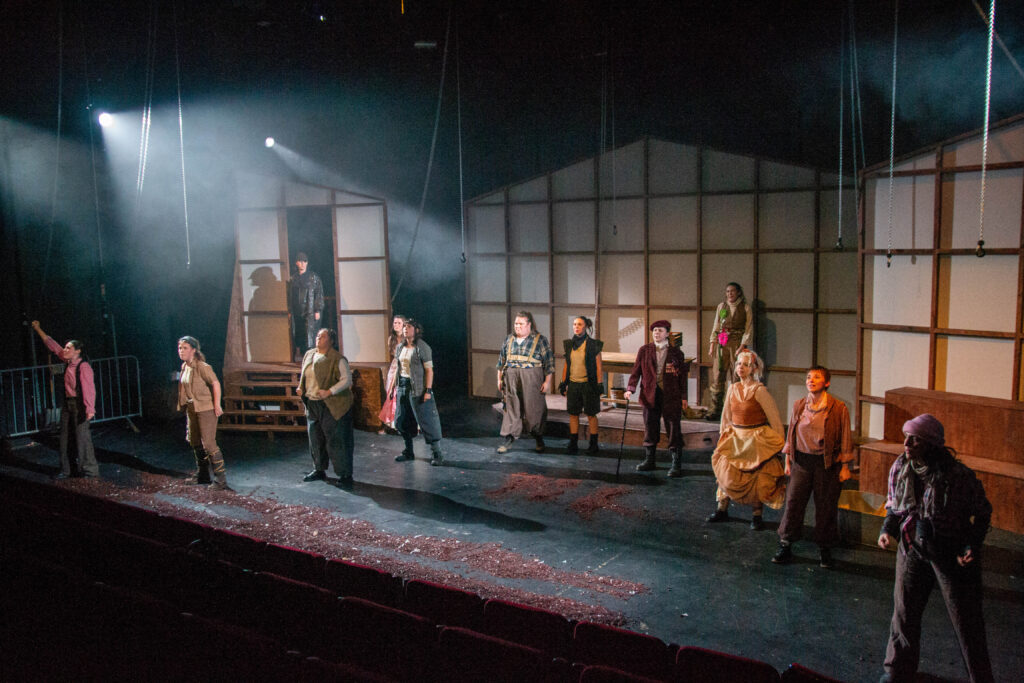
Going into the play, the biggest question for me was how the animals would be visually portrayed. Within ten minutes, my worries had dissipated. The need for large, exuberant costumes is made redundant by minimalist clothing and accessory selections, a decision that perhaps creates the play’s biggest strength. The absence of clunky masks and articulated costumes allows the impressive simplicity of the outfits to become a platform for the captivating acting to shine through in the intimate venue of the Grosvenor East Theatre.
Each character’s outfit features a period-inspired, subtle nod to their respective animal: a gathered and layered skirt for Clara the Hen, played by Augustina Gabriela Bujor; a pale pink beanie for Vicki Glover’s Snowball the pig; and a lederhosen-esque chest strap, paired with a high ponytail for Boxer, the cart-horse, played by Jayne Stratford. These are just some of the standout examples of the costume ingenuity on show. These subtle details, found in the restraint of costuming, combine with the immersive and devastatingly emotional acting on offer, to leave me wondering why I ever questioned it.
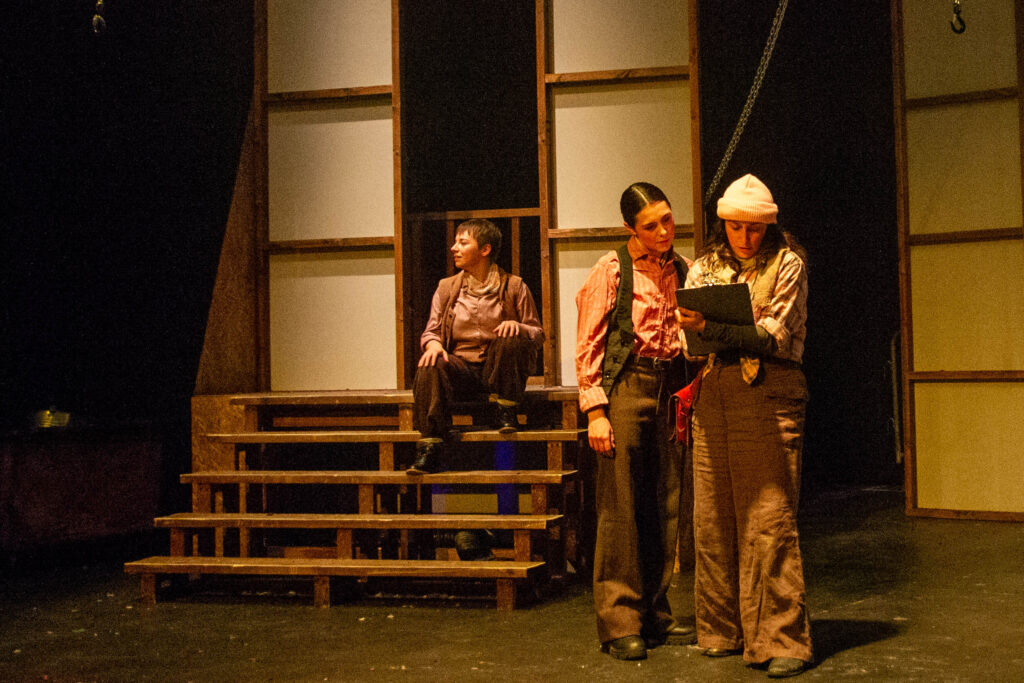
While staying true to its mid-century origins in costume, the production features a contemporary edge in the form of techno music, bass guitar and electric notes, providing fast-paced scene transitions and injecting atmospheric horror into the more thrilling moments. Fairhurst’s production also sees Orwell’s ‘propaganda pigeons’ transformed into a bicycle-riding comic reprieve in the form of Jessica Durber’s modern talking, streetwise city pigeon, complete with a purple and green plumage outfit and large hoop earrings.
Perhaps the only scene that doesn’t quite land for me was is when Boxer, played by Jayne Stratford, is taken away in the truck, destined for the factory. Clover, played by Ariana Parr, and Benjamin, played by Mariko Matiato, realise that Boxer has been tricked into the back of the glue-maker’s lorry. We see a frantic Boxer trying to escape the confines of the lorry via the back of the set, when suddenly, a brightly lit video of a lorry appears, enormously projected on the set behind the actors. I feel this jars with what is otherwise an intensely moving scene, creating an unnecessary break in the drama and pulling me out of the moment.
Despite this momentary distraction, the strength of the performances remains undeniable. Looking at the common people, who are often the ones most affected by the movements found in Orwell’s tale, Ariana Parr’s portrayal of Clover provides the moral centre of the story, questioning the injustices befalling her. Clover’s internal struggles are presented outwardly as she fights between what she knows is right and what she can realistically do. Parr’s understated emotions, simmer just enough beneath the surface to make them truly believable. When she and Clara talk of their children, a sense of deep longing and injustice draws me into the plight of a mother finding herself without her children that she has given for the ‘greater good’. It is a moment that stays with you, particularly when Clover is helpless to prevent the death of Clara. Parr once again pulls you right into the emotional rawness of her acting when she is seen digging into the dirt of Boxer’s fresh grave.
Augustina Gabriela Bujor’s portrayal of Clara the Hen is a surprise performance for me. What begins as a lesser character develops into a mother hysterically fighting for her children and culminates in a gut-wrenching death where feathers fall from above and blood pours from her neck. Bujor’s performance leaves me reeling from her harrowing cries as she finds herself in the throes of death. Ava Irving’s Blue perhaps delivers the most consistently convincing animalistic performance, staying in character and selling the role of the dog though yaps, ear scratches, and head tilts, even when away from centre stage.
The result is a compelling warning into the hidden agendas driven forward secretly under the guise of freedom, that we have all seen before. Power struggles, greed, murder, betrayal and regret are all expertly conveyed through multi-dimensional acting and comic undertones, culminating in a wonderful sense of storytelling that stays surprisingly true to the source material.
Across four sold-out shows at the Grosvenor East Theatre, Animal Farm is met with an opening night standing ovation. It marks the first play of the brand-new season ,and its success promises great things for the forthcoming season, with four more plays scheduled across the year.
The cast
Benjamin – Mariko Matiato
Blue – Ava Irving
Boxer – Jayne Stratford
Clara – Augustina Gabriela Bujor
Clover – Ariana Parr
Farmer Jones/Pilkington – Freya Tamiozzo
Milo – Jessica Durber
Minty – Mayan Davies
Mollie – Estelle Joynt
Napoleon – Loo Tompson
Newsreader/Minimus – Molly March
Nutmeg – Emilia Frymann
Old Major – Niamh Hill
Snowball – Vicki Glover
Squealer – Katherine Chambers
Director: Jimmy Fairhurst
Adaptation by Tatty Hennessy
The Manchester School of Theatre’s next production, The Wife of Willesden by Zadie Smith, runs 19–21 November. Book your tickets online.