
Wicker film review: “Safer not to see your fishy self at all” – Wicker holds up a mirror to society’s rot
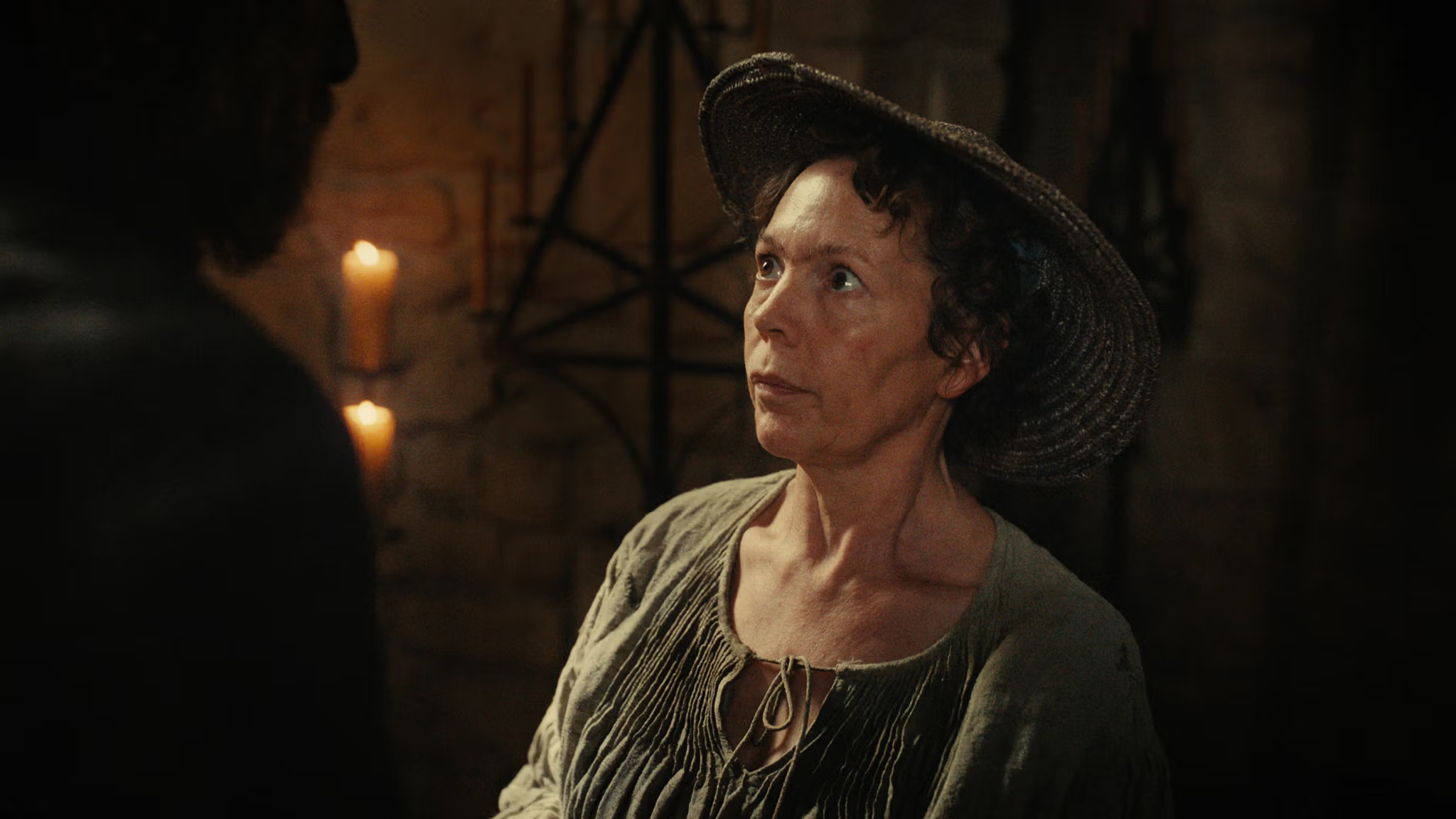
Featured image: Press/Black Bear Productions
First etched into our collective consciousness in late July, in the form of a steamy, obscene and outright ridiculous teaser trailer featuring Olivia Coleman shacking up with a twigged-out Alexander Skarsgård, Wicker (2026) promised a spectacle. Skarsgård’s press tour outfits also attracted incredible attention for their bizarre nature. Yet what arrived in cinemas was something rather different: a soulful and masterful love story that left its female characters – and viewers – pining for a pine lover of their own.
Seeing it in 4DX is a different experience altogether, but the message remains much the same: fellas, is it gay to love your wife?
The film opens in an olde English town where men are known by their occupations and women, naturally, by their relationships to men. The ‘Tailor’s Wife’ was once the ‘Doctor’s Daughter’, her identity always tethered to a man. It is not so far removed from our own naming traditions, but seeing the practice laid out so plainly is jarring. As someone who has little attachment to my surname, I can’t say I’m against the idea of changing it, but Wicker’s depiction of this convention has certainly made me question it. In laying bare the absurdities of the village’s traditions, the film holds up a mirror to our own society, exposing the rot beneath customs we have long accepted as normal.
No tradition is quite as alarming as the marital collar. Mirroring modern wedding rings and eerily reminiscent of mediaeval chastity belts, these ‘wedding collars’ force viewers to confront the sense of ownership men can feel over the women they intend to marry. By drawing such an explicit parallel to modern customs, the film invites us to reconsider the archaic marital practices we still use today.
Olivia Coleman’s character, the Fisherwoman, dispenses with these traditions in her unconventional wedding to Alexander Skarsgård’s Wicker Husband. Yet this changes remarkably little. She is still married, just as the other women in the village are. If anything, she and her husband appear to be living considerably more happily than the rest of the village.
It is the Wicker Husband’s conversation with the town’s husbands, however, that offers the simplest dismantling of their beliefs. He asks an apparently innocuous question: “Do you love your wife?” The result sends all of the husbands into a frenzy. It takes a naive, Frankenstein’s monster-esque creature to pull back the curtain, almost by accident, and reveal that the husbands have forgotten something rather fundamental: you are supposed to love your spouse. Then comes the shocking revelation that the Wicker Husband and Fisherwoman – as unconventional as they may be – have perhaps the most normal and genuine form of love in the entire town.
The men are particularly hung up on the fact that the Wicker Husband goes out of his way to make things better for his wife, simply to make her happy. They regard him as effeminate, less of a ‘man’, precisely because he loves his wife. So I return to my thesis question: fellas, is it gay to love your wife?
The Tailor’s Wife is perhaps the film’s most interesting character. She benefits from the patriarchal system, she is a leader and wields more power than her husband among the townsfolk. But despite this, and her clear competence in medicine and business, her ideas for expansion are shunned and the credit for her work goes to her husband. Call it hubris, but I can’t help but feel sorry for a woman so deeply entrenched in the system around her, and seemingly so close to escaping it, only to have it taken from her. Hers is a cautionary tale: complicity is choosing a side. Her attempt to sabotage the relationship between Fisherwoman and the Wicker Husband so clearly stemming from jealousy of the freedom they enjoy.
The Fisherwoman’s eventual attack on the Wicker Husband, brought about by the meddling of the Tailor’s Wife interference demonstrates how society can distort our perceptions of even those we love most. No one is immune to such pressures, not even an ostracised woman who has seemingly escaped them.
And finally, my personal favourite: the Wicker Woman. What a moment she has in serving the town exactly what it deserves: female rage personified – or, well, ‘woven’.
Ultimately, Wicker is an unexpectedly tender film that questions the traditions our society continues to cling to. It’s a great choice for girls’ night out. 4DX is by no means essential, but it comes highly recommended. Boyfriends are not advised.