
Opinion: “Does hating purple make you sexist?”
By Imogen Burgess | Featured image: Imogen Burgess
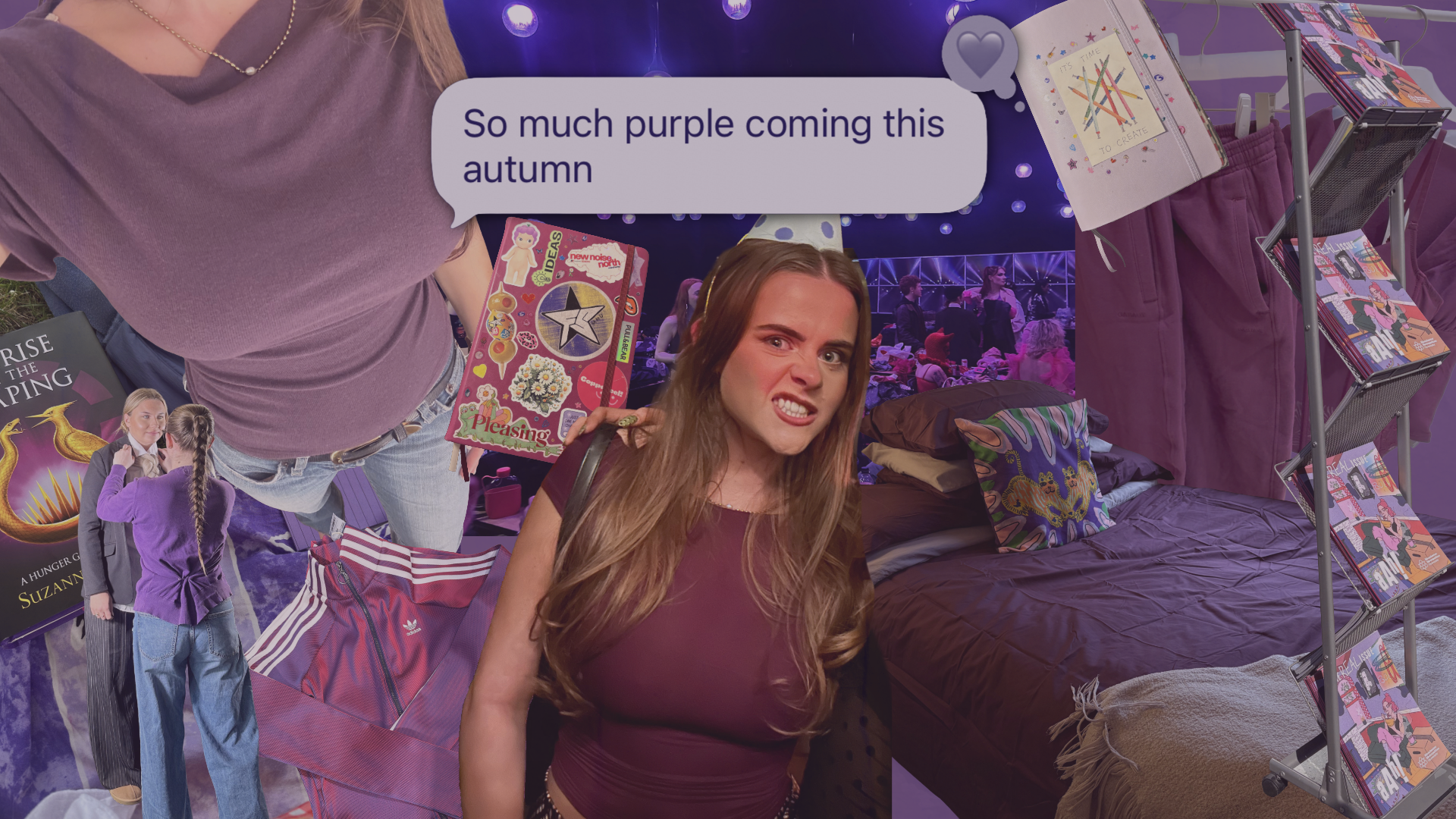
When global trend forecasting authority WGSN named “smoky amethyst” a key colour of the next few years, I felt the shift: purple is cool again. Fashion articles have been published in their dozens naming purple the ‘colour of the season’ for autumn 2026, but as a steadfast purple lover myself, this shift is unwelcome.
For years, whenever someone found out that my favourite colour was purple, they rolled their eyes and teased me for it. Granted, I fall into the stereotype of a quintessential purple girl (see any TikTok skit on the matter), but the disdain for purple enjoyers always struck me as strange.
There is a phenomenon where brands will list products as ‘purple’ when they’re clearly not. Take this Bershka strappy top, listed as purple but which is so obviously brown, or this iPad mini, described as ‘purple’, but grey at best. This almost reluctance to make actual purple garments and products feels odd.
Looking at data about people’s favourite colours, split by gender, reveals the disparity. Green and orange score similarly for both men and women, with red pulling in more women and blue more men, but purple is cited as the favourite colour of zero men.
Granted, this is one data set, but the sheer lack of preference is surely something to take into account. It should be noted that purple ranks second-highest for women, just behind blue. Purple isn’t just not favoured by men, it’s also rated the least-liked colour by men, showing not just an apathy for the colour, but a conscious dislike of it.
This phenomenon, which I’m dubbing the ‘Purple Gender Disparity’, finally made something click for me: after all these years, people’s disdain for the colour purple was patriarchal!
But how did we go from purple being associated with royalty and luxury, much of which is still true today, to a societal contempt for the colour?
Perhaps in a similar way that pink was once considered a masculine colour and is now used to signify a girl at baby showers, or how tights and high heels were worn strictly by men, and now wearing them would go against societal norms. Things naturally move in and out of fashion as time goes on.
Or maybe it’s similar to the concept known as ‘college feminisation’, wherein degrees that become dominated by women are viewed societally as less academic. For example, when interior design degrees began to be attended by more women than men, they were seen as ‘easier degrees’.
The same happens inversely: degrees like computer science, which were once seen as womanly and lesser, have become male-dominated and consequently, more respected. Aren’t degrees in general viewed as less valuable now, at the same time that women (56%) are enrolling at university in greater numbers than men?
But isn’t it an age-old truth that things enjoyed by women are perceived as trivial, futile and asinine?
We can’t forget that purple was one of the key colours in the fight for women’s suffrage. Purple is the ultimate feminist colour – another reason why our increasingly right-leaning society may dislike it.
No, disliking a certain colour does not make you inherently sexist, but it is interesting to consider how societal pressures and subconscious bias can shape our opinions.
But, for the record, purple is the best colour ever.