Featured image: Evie Atkins
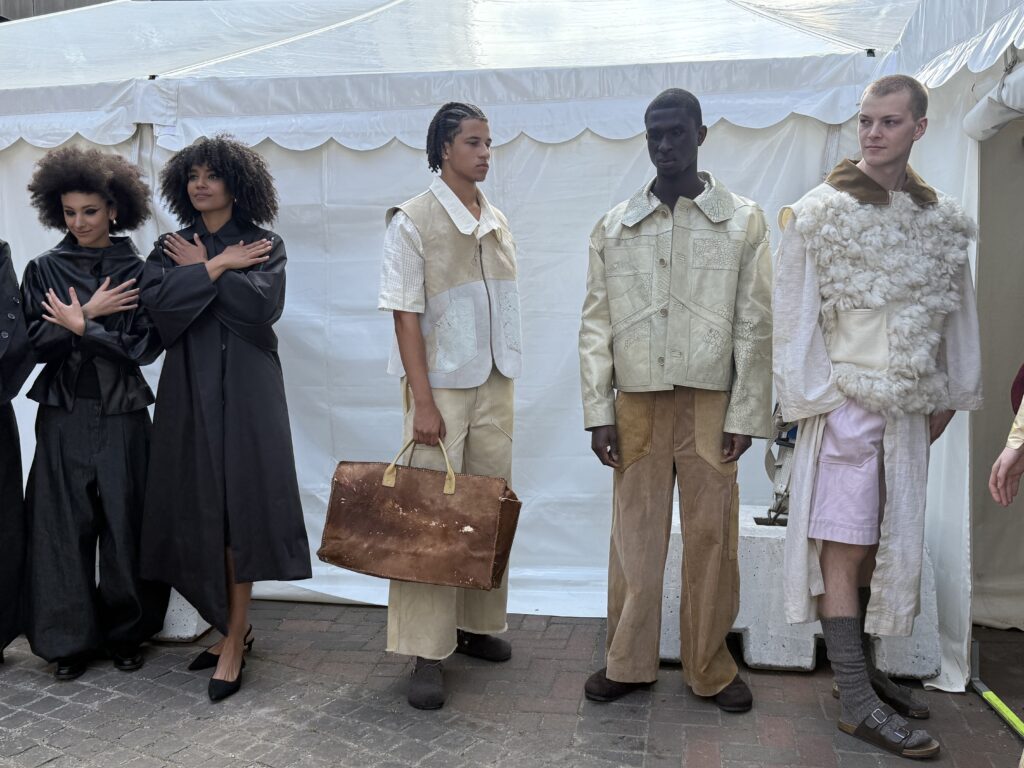
When Vogue Business asked the question on everyone’s lips – “Is Manchester the next big fashion city?” – the world was forced to pay attention. The publication spotlighted Manchester Fashion Institute (MFI) and Manchester Met, highlighting the 1,800 students training to be the next generation of designers and fashion change-makers.
For those of us already here, this moment feels perfectly timed. With the British Fashion Council pledging to decentralise fashion week – bringing activations to cities like Manchester, Liverpool and Newcastle, this isn’t a passing trend. When Channel hosted their 2023 spring/summer show here, people were at best confused, but this shift up north feels like an evolution rather than a pendulum swing, and something that will actually stick.
Manchester’s fashion community has been quietly confident in this fact for years. MFI is approaching its ten-year anniversary, but the city’s design heritage dates back to 1838 with the founding of the School of Design. There’s no denying Manchester has a rich history of fashion, this new attention simply confirms it. But as Manchester’s position as the next big fashion city feels preordained, what does this mean for the fashion creatives actually in the city at the zeitgeist of this fashion movement?
As Manchester’s fashion scene gains more traction, more industry players are heading north. Manchester brand consultant Melissa Bell notes an “influx of CVs coming from London,” reflecting a shift away from the capital’s oversaturated market. This move brings opportunity and tension. Graduates hailing from prestigious institutions like the University of Arts, London and Central Saint Martins bring experience and networks that perhaps Northern creatives just don’t have access to.
These people could be seen as a threat to those who are from or now live in Manchester. There is still undeniably a stigma of seeing Manchester as a sportswear specialist at best, and at worst, a fast fashion hub. But these people are seeing the opportunity, they’re believing in the longevity of Manchester, hence their trust in moving up here. Manchester’s creatives are already a piece of this culture, you’re close to the community here and it only takes one bus to immerse yourself in it.
Manchester is small – enclosed, deeply connected and manageable. Its fashion scene feels the same way: a close-knit community where everyone seems to know everybody, as is the Mancunian way. “If I’ve ever wanted to do a pop-up, or needed a photographer at the last minute, or if I need clothes for a shoot, I’ve been given so many things for free — the community here is really supportive,” says Natasha Fernandes Anjo, a young northern designer.
Junior Clint, founder of streetwear brand Clints, echoes this sentiment: “In Manchester, I think you can try things out without the pressure of what it looks like from outside. When I started, there was almost an instant impact in the city. People out here are very supportive.”
There is also this feeling of people you don’t even know cheering you on, there are industry players who have been around for longer who feel this intrinsic need to provide for the next generation, our generation. Luxury fashion brand owner and designer Nadine Merabi describes this as a responsibility: “You’ve got so many young, creative, brilliant minds finishing university. It’s our responsibility to make sure that we continue to build these businesses in the North so that more people feel they can stay here.”
Manchester’s fertile grounds seem to be the perfect place to plant the seeds of a new brand and a place to grow roots around within your brand identity. With a market value of around £2.8 billion and employing almost 50,000 people, it is the second largest fashion hub in the UK. Across industries, countless successful brands trace their humble beginnings back to Manchester. There’s more than hope here – there’s solid proof there’s something worth sticking around for.
Notorious and unapologetically northern fashion brand Drama Call’s founder Charlie Bows reflects on this: “Maybe we’re losing our roots a little, but there’s more opportunity now. There are founders to look at as a blueprint if you want to start something up, which we didn’t have when we were younger. And it’s not just fashion, it’s music, photography. It was sometimes hard to gain that inspiration in the city. But now there are so many people doing amazing things. It gives kids and young [entrepreneurs] hope.”
Many of the readers following this story will be Manchester Met students – part of a university recently named the Modern University of the Year 2026. When Vogue Business highlighted MFI’s 1,800 students, it was as numbers on a page; yet for those training at MFI, it’s only a matter of time before individual students are recognised by name as the designers shaping Manchester’s fashion future.






Leave a reply