Photography: Mark L. Hill. Design: Monica McManaman
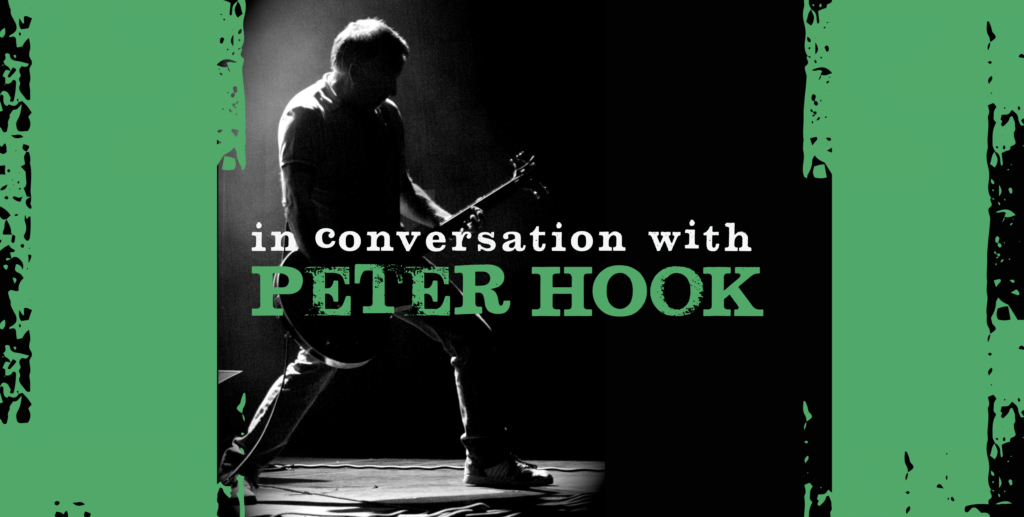
The Manchester figurehead talks to aAh! about his experiences as an adolescent musician finding his way in the city.
Before his time as the revered bass player for Joy Division and New Order, Salford-born Peter Hook dedicated his adolescent years to frequenting gig venues across the city. “The Hard Rock in Stretford became a B&Q,” Hooky tells me. “I saw Led Zeppelin there and David Bowie. I saw Deep Purple and Frankie Valli and the Four Seasons at the Free Trade Hall; I don’t think any of your students will know these names!”
At a Sex Pistols gig at the Lesser Free Trade Hall in June 1976, Hook became acquainted with fellow Salfordian, Bernard Sumner. Together the two would form post-punk pioneers Joy Division. “It was at the age of 20 for me when it all changed,” he recalls.
Hook soon took to the stage with bandmates Sumner, drummer Stephen Morris and singer Ian Curtis. “One of the first venues we played in was The Squat which was on Oxford Road,” Hook remembers, since it was demolished to make space for the expanding university campuses. “Music venues in Manchester were changing all the time. I became more aware of the smaller venues; all the shitholes in Manchester.”
Hook describes his early twenties as a trying time cutting his teeth with Joy Division. “I’d like to say I learned patience,” he chuckles. “Once you’d formed a group the most important thing in the world was getting a gig and of course every other group in Manchester wanted a gig as well. The competition became very intense, real dog eat dog, every man for himself. It was a hell of an education.”
With Hook at the fore, Joy Division jostled for dominance amongst their peers, making their fair share of allies and foes. “My favourite Manchester band at that time would’ve been 10cc [who owned Strawberry Studios in Stockport and had hits including ‘I’m Not in Love’ and ‘Dreadlock Holiday’]. I wouldn’t have known any other Manchester bands until I formed the group when all of a sudden they appeared like cockroaches out of a drain!” Hook still harbours his decades-old grudges. “I hated every other band with a passion,” he laughs.
Joy Division split following the death of Ian Curtis in May 1980, but Hook still speaks fondly of his first band: “The strange thing about being in a group is that you have to have a lot of self-belief and a lot of confidence in your group and in your group members. It instantly makes it a very tight family and you become very protective of the music and of the band. I can tell you for a fact that hasn’t changed in 48 years.”
Between his time playing in bands, Peter Hook had a profound influence in fostering the acid house and rave scene in Manchester. The Haçienda nightclub opened in 1982 and was run by Factory Records manager Tony Wilson. Hook recalls his memories of the nightclub: “At that time there was nowhere to go out in Manchester. Manchester is the place it is today because of The Haçienda and Factory Records, Joy Division and New Order.
“One of our biggest achievements was that every university or college in Manchester was five times oversubscribed because of The Haçienda.” The defunct nightclub has since been resurrected as Factory 251, a popular student haunt in the old offices of the record company.
The incredible tale of The Haç is told in Hook’s book How Not to Run a Club. Inevitably, the club closed its doors in 1997 after problems with drugs, gangs and losing copious amounts of money, and the flats which took its place also bear its name.
For Hook, it’s essential that the punk spirit he pioneered continues to resonate with younger generations. “We were assaulted in the streets for being punks,” he says. “Yet now it’s an accepted tribe of music… The most wonderful thing in the world is inclusivity.”
Hook concludes with a poignant but plainly put message to the students of the city, with hopes of a bright future for Manchester’s next generation: “Students are very important because the world is going to be yours next… Don’t be afraid to do what you want to do.”
Follow @peterhook_thelight on Instagram.





Leave a reply