By Morgan Stewart
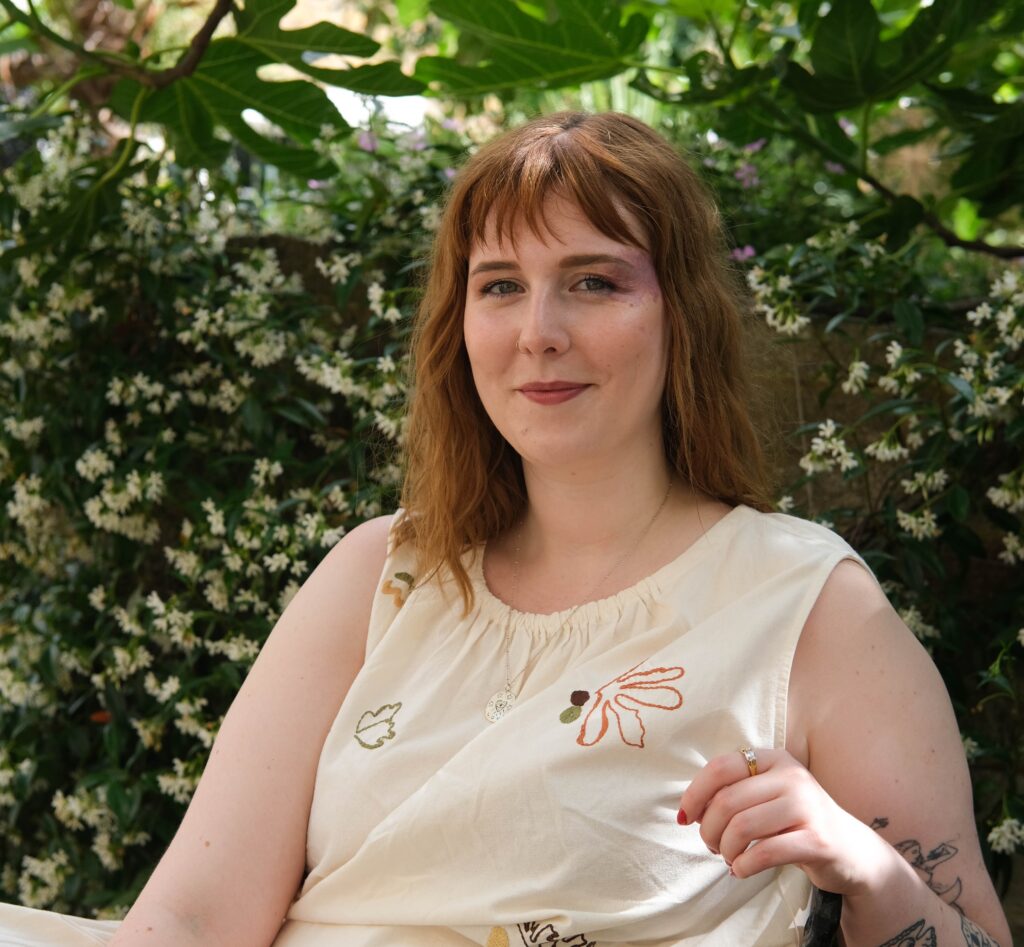
Poet Charlotte Shevcheno Knight will join the 16 Days of Activism Against Gender Based Violence Festival line-up this weekend. An activist, PhD candidate, and creative writing tutor at Manchester Met, Shevchenko Knight’s work bridges personal experience and broader societal critique, focusing particularly on the medical field.
Shevchenko Knight will appear alongside Naomi Morris and Char Heather on Sunday 1 December for a panel discussion on feminist approaches to illness narratives and gender inequality in medicalised spaces.
Drawing from personal experience, Shevchenko Knight highlights persistent gender biases in medical spaces: “I feel like there is no quick, easy fix to any of this, and I feel like we’re still very much living in the wake of the ideas like hysteria being introduced as a kind of ‘women’s condition.'”
She emphasises that this legacy continues to shape treatment, often unconsciously as women’s pain is frequently dismissed or misattributed: “It won’t be like, ‘Oh, you’re hysterical.’ It will be something like being told you’re probably feeling anxious. And the conversation to be had around there is that is: anxiety is a symptom, right? It’s not. It’s a symptom of something else – and it’s a rational symptom as well.”
Reflecting on her own experience, she recalls: “I was in hospital over the summer saying that something’s really, really wrong. I told them, ‘Something is really wrong with my chest; I can’t breathe.’ And they said: ‘Oh you’re probably having a panic attack, or maybe you have a chest infection. After 18 hours in the waiting room, they told me: ‘Oh you had a blood clot in your lung.’ I was like: ‘OK, well, thanks so much for that. I could have told you that. And I was telling you that, but you didn’t listen.'”
Shevchenko Knight also critiques the way pain is assessed in medical settings: “When we’re asked to rate our pain from one to ten, men are much more likely to rank their pain higher than women are. That doesn’t mean that women are not in the same amount of pain. But even when women do rank their pain on the same kind of scale as men, they’re not believed.”
Following the panel discussion, Shevcheno Knight will read from her debut poetry collection, Food for the Dead, at a reading and discussion alongside poet and playwright Anjum Malik on 5 December.
Shortlisted for the Forward Prize for Best First Collections, the collection delves into four generations of women in her family, unearthing how heritage shapes our understanding of family dynamics. She describes the book as a meditation on “memory in present tense,” aligning with the festival’s themes of resistance and healing.
Her poetry often explores themes of longing, loss, pain and resilience, offering a lens to address gender inequality and violence. Speaking about her collection, Shevcheno Knight says: “Food For The Dead looks at different generations of women in one family and that was a really conscious choice. I could have talked about the men in my family too, but I felt like it was pretty important to me to highlight how much work and resilience each woman has carried.”
She added: “I’m really interested in female characters or female figures as an important way into a wider issue. By talking about very specific people in my life, I’m able to then relate that back to historical discrimination or inequality. I think by touching upon an individual’s loss and grief and love and desire, it can give [readers] a point of empathy – a way of accessing a history and that you’d otherwise feel a bit disconnected from.”
She views writing as a tool for change: “If we can’t get people to listen to us, nothing will change. Writing is a place where empathy can be your best tool, and you have to think really, really cleverly about it and and be really critical in in how you employ empathy.”
While she acknowledges the cathartic potential of creative writing for survivors, Shevchenko Knight also warns of its risks. Reflecting on Emily Berry’s essay Further Injury: Surviving Poetry, she notes how writing can evoke difficult emotions.
“Berry talks about feeling jealous when others said poetry saved their lives because she felt that it was making hers worse. But she couldn’t stop engaging with it. And this is something that I think people don’t talk about sometimes: negative feelings do arise from writing. We need to find ways to protect [ourselves].
“I’ve been talking to some of my creative writing students about how much we give away in a poem. I think [sometimes] we maybe don’t expect people to read poems and so we feel that we can say whatever we want without much repercussion.”
Reflecting on what Shevchenko Knight hopes attendees leave the festival with a sense of hope and possibility: “There’s a lot to work on, but we also have the ability to work on it. We’re not complacent; we’re not goldfish. Writing and reading can be powerful ways to engage and make change. Writing is a space of possibility – you can literally write anything you want. That’s what I hope people take away from this festival: a sense of hope and possibility, because it’s so needed right now.“
Join Charlotte Shevchenko Knight, Naomi Morris and Char Heather for a panel discussion exploring feminist approaches to illness narratives and gender inequality in medicalised spaces on Sunday 1 December. Book your tickets here.
This will be followed by a reading and discussion with Charlotte Shevchenko Knight and Anjum Malik on multilingual poetry readings exploring gender hierarchies, the female body and hunger on Thursday 5 December. Book your tickets here.
The 16 Days of Activism Against Gender-Based Violence Festival runs from 25th November to 10th December, 2024. For more information and tickets, visit mmu.ac.uk/news-and-events.


Leave a reply