Through the arches of aged brick and rusting iron beams stands a new window of opportunity, honouring Manchester’s industrial pioneering of the past, while looking forward to the city’s essentially eco-conscious future.
In the historical neighbourhood of Castlefield, a 330-metre long viaduct has stood undisturbed and derelict for decades. After becoming overrun by nature’s due course, the Grade II-listed structure was soon blanketed by a long carpet of grassy overgrowth, with the track rendered redundant following closure in 1969.
Once construction was completed in 1892 by engineers Heenan and Froude (of the Blackpool Tower), the viaduct acted as one of many gateways for production in the industrial revolution, used to transport ‘heavy rail traffic’ to and from the Great Northern Warehouse. Today, it has found a new purpose.
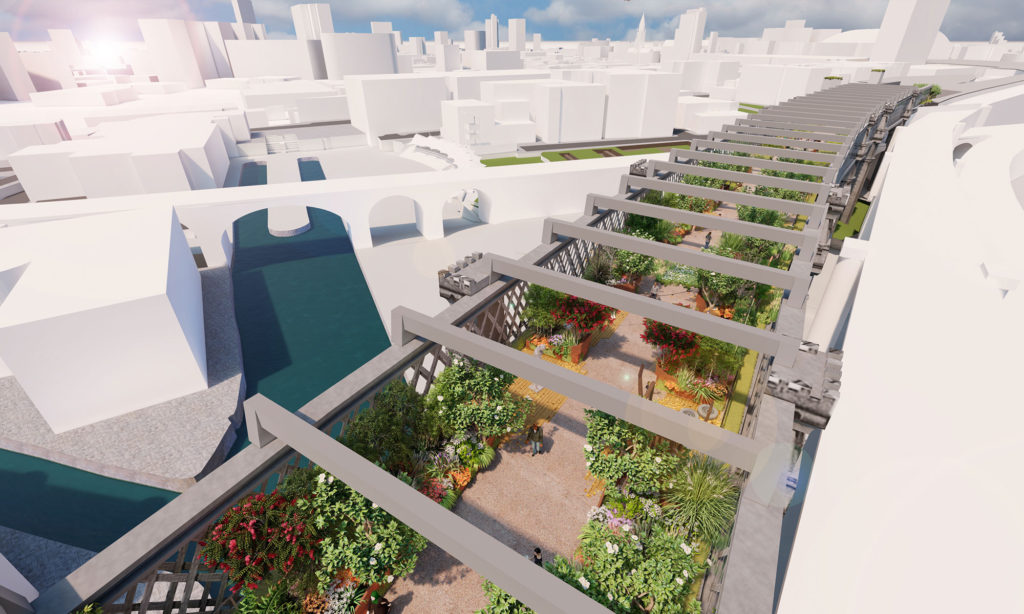
No longer serving as a relict, the viaduct is set to open as a ‘sky park’ at the end of July, a unique inner-city green space encouraging an ethos of sustainability and local community.
The £1.8 million project has been funded by private donations and financial support from the People’s Postcode Lottery players.
The Plan for Castlefield Viaduct
Major project partner, the National Trust said: ‘The vision is to transform Castlefield Viaduct into a free-to-access park and meeting place for people and nature. It will be a space that respects the listed structure, celebrates the nature, beauty and history of the viaduct, and fits in with existing plans for the city.’
Calum McGowan, Chair of Castlefield Forum, said: “To be approached by the National Trust to help galvanise our community around this project is something we have run straight towards and we are thrilled to be working alongside them. From the humble beginnings of the Forum we have often stared up longingly at the old viaduct, thinking “what if?”. We have always had it in our sights to bring it back to life, but now there’s a very real chance the viaduct will be back in use. And sooner than we had ever expected.”
Other partners include Manchester City Council, Transport for Greater Manchester, National Highways Historical Railways Estate Team, Greater Manchester Combined Authority, as well as Castlefield locals.
‘Phase One’ is a year-long experiment in which staff, volunteers and associates will be assessing and learning what works effectively and what may need improvement.
While creating as little waste as possible and sustaining a ‘net-positive impact on the local environment’, visits will need to be booked in advance.
Meanwhile, feedback from attendees is widely encouraged to inform the long term features of the viaduct’s ‘Phase Two’.
Twelve Architects and Masterplanners
Sustainability and biodiversity at the forefront
With the biodiversity changing in species and variations as the seasons pass, the National Trust is collaborating with partners Castlefield Forum, Urban Wilderness, City of Trees, and the Science and Industry Museum, in the shaping of four distinctive gardens.
The sky-park will feature a dynamic and serene ‘Secret Garden’, as well as an area of ‘Naked Viaduct’, preserving the space as it is now ‘to provide a sense of how nature has reclaimed the space’.
The carefully selected plants have been inspired by Manchester, including cotton grass (as the city’s ‘county flower’) and oak trees ‘underplanted with the Red Rose of Lancaster’. Rainwater will be collected to water vegetation, air quality will be observed, and waste is set to be disposed of responsibly.
Twelve Architects and Masterplanners
Castlefield Viaduct’s long standing history
Castlefield was once a Roman settlement back in 79 AD, known as Mamucium, before it was deserted in 410 AD and left to deteriorate. Years later, in 1086, records suggest a village named ‘Mamcester’ arose nearby, eventually expanding to include the previous Roman site.
The turn of the industrial revolution established Manchester as a city of manufacturers, particularly in cotton, after the Duke of Bridgewater enlisted James Brindley to build ‘one of Britain’s first canals to transport coal from his mines at Worsley to Manchester’. However, it soon transpired that a more streamlined method of transportation was needed: railway.
The ‘world’s first inter-city passenger railway station’ known as Manchester Liverpool Road was established in 1830. In the following years, an abundance of warehouses were created to facilitate the ever-growing industry within the city, including the Great Northern Warehouse in 1855. The Castlefield Viaduct was built in conjunction with this in 1891.
Featured image: FX / Disney Press Following the premiere of the limited anthology series Love Story (directed by Ryan Murphy) on Disney+ earlier this February, show protagonists John F Kennedy Jr and Carolyn Bessette have become favourites for a new generation. Almost 30 years after their real-life untimely passing, the show’s popularity has unleashed a…
By Holly Lindsay and Amelie FalconerFeatured image: Jamie Taylor Remember nestling into your parents as they read you the worlds of Harry Potter, The Faraway Tree and Charlie and the Chocolate Factory? Unfortunately, not all children get the opportunity to create a lifelong love of reading, as 1 in 8 children in the UK currently…
Featured image: Leire Ribeiro I remember a time in music when a VIP concert ticket bundled with a meet-and-greet and early entry would not cost more than £150. Today, we have artists like Harry Styles selling tickets for £725 with no soundcheck and no meet-and-greet, the only bonus being good visibility at the show, which…
Featured image: Fabiola Gonzalez Prato Every single day I hear someone complaining about not being in a relationship. I go online and watch videos of people who are tired of going on dates with those who “only want a good time,” eventually deciding that staying single is for the best. These days, the reasons behind…







Leave a reply