By Justine Chamberlain
With its £10,000 jackpot, The Manchester Poetry Prize is one that all poets set their sights on, both new and experienced. I ask judge, Adam O’Riordan, about where poetry is in 2014 and what winning a competition like this can do for a poet.
People keep questioning whether poetry is dead, is it? Or are we asking the wrong question?
Good question. I’ve always thought that poetry is a function of language so it’s never going to die because it’s simply the most intensified form of language you can find, so the short answer is no.
At the Forward Prize, Jeremy Paxman said poetry must engage with ordinary people. Who do you think he was talking about?
Good question again. You’d have to ask him. I think certainly the poets and poetry I’m most interested in meets the reader or listener part way, so I think some form of engagement has to take place. If it’s too opaque or too distancing, then poetry isn’t doing what it can. When we workshop poetry here [The Manchester Writing School], often it’s about hooking the reader in. Once they’re in, you can complicate things and change things around if you can get that initial connection, that’s where the poetry starts to work. I hope that’s what he’s talking about, that initial spark that connects a reader or listener to a poem.
Do you think poetry should be clear or is there a place for the more oblique?
Great poetry and all great art shouldn’t make things simple; it should get into the complex nature of things. As a starting point, if it draws a reader in, that’s the important thing. I think the less successful poems put the barriers up at the start rather than drawing the reader into the maze and the labyrinth. They stop them from entering and are missing the point of poetry.
I’ve heard criticism that poetry is becoming too academic. Do you think poetry is going down a more academic path rather than open to a moderately educated person?
I don’t think so. I think it’s a really good thing for poets and readers that the poets have this home in universities now. It gives people a place to come to, to study to improve their craft. I think it’s a really healthy relationship. As long as the poetry’s still reaching people and has an openness to it, then that’s the important thing. The question that’s often asked is why these creative writing schools don’t always produce writers but I think that’s missing the point slightly. The important thing is that it’s producing people who can access their talent, sure, but also producing more informed readers- people who have thought about poetry more deeply, in a more engaging way. I was talking to a barrister about it recently and she said ‘yes, but that’s not what they signed up for’ and she had a point, but actually what it’s about is that the quality of their reading will inform their writing and generally raise the quality of their writing. It’s a complex interconnected thing.
So when you’re judging the Manchester Poetry Prize you’ll be looking for some way to get into the poem, to have that entry.
Yes, but the great thing about the Manchester Poetry Prize is that it’s a mini collection of poems and that makes a really big difference. Looking at a small body of work, you can get a sense of what the poet’s doing and how they’re making things work. In the past three years it’s been apparent the prize has been awarded for the collection of poems they’ve submitted, and that’s what makes the prize unique. It’s nice as a judge to be able to see these things and when we have the judges meeting to talk about how the sets of poems function.
When you’re looking at the sets of poems, are you looking at something consistent across the three or hints that the writer’s got range?
It could be either. Overall we’re looking for quality to be shown throughout the sets of poems and that could be through the diversity of radically different poems, or it could be three great simple sonnets; as long they’ve got that quality we’re looking for.
You mentioned sonnets. Poets make a choice whether to use formal tradition or free verse. Is there a particular type you expect to see in a competition?
Not at all, it’s completely open. It’s not at all prescriptive. We’re looking for that thing that’s very hard to set down in criteria – that spark. In the same way that if you pick up a book of poems and you really like it, you won’t necessarily be able to articulate immediately what it is you like about it – you have that quickening when you read it – it demands your attention. That’s what we’re looking for in the poems we’ll be looking at.

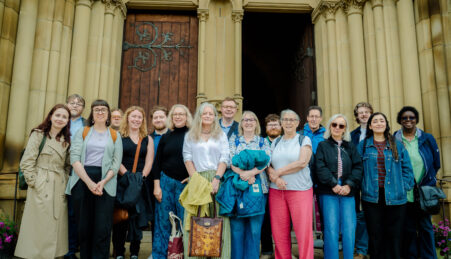
2013 winner Pascale Petite (centre) & the Shortlisted Poets
The poetry prize has obviously got a very large sum of money at the end (£10,000), but besides the money, what can winning a poetry prize such as this do for somebody, perhaps if they’re looking for a poetry career or getting involved in the literature scene?
I imagine that’s the most important thing for the entrants – no one enters into poetry to make money. The money is a fantastic thing and it’s great for a poet to get a chunk of money like that, but the important thing is the function of drawing attention to the poet. It makes people like magazine editors, publishers and other writers pay attention to this person. In the clamour of the poetry world, that’s the biggest prize. We have the shortlist as well to make sure they are commended, it’s not just about the winner. It’s great that we can highlight the poets we like from the entrants.
Adam O’Riordan’s collection In The Flesh was released in 2010 by Chatto and Windus and he is senior lecturer in Poetry Writing at Manchester Metropolitan University. He is a judge in the Manchester Poetry Prize.
Anyone hoping to win the Manchester Poetry Prize 2014 will need to submit online by 5pm Friday 29th August to be in with a chance of winning £10,000.
Justine Chamberlain is joint editor in chief at Humanity Hallows, and a poet and creative writing student at MMU. She blogs at justinechamberlain.blogspot.co.uk and tweets @JustinesWriting. She plans to take over the world by 2025.





Leave a reply