Featured image: Evie Peattie
Often overshadowed in popular narratives by the heritage houses of Paris or Milan, London’s fashion ecosystem has long traded on creative freedom. As London Fashion Week prepares for its 42nd year, running from the 19 to 23 February, the British capital is poised to reaffirm its reputation not simply as a global fashion hub, but as a launchpad for emerging voices redefining how we think about style, identity and cultural production.
This season’s schedule – curated by the British Fashion Council – reflects that legacy while highlighting the designers who could soon define its next era.
While household labels such as Simone Rocha and Burberry remain fixtures on the calendar, London Fashion Week extends its platform far deeper into the creative community. New designers including Aaron Esh, Charlie Constantinou, Oscar Ouyang, and Talia Byre will also showcase their work.
The BFC NEWGEN initiative – arguably the backbone of London’s emerging talent pipeline – is once again central to the week’s programming. Established to provide financial support, mentoring and high-profile opportunities, the scheme has played a pivotal role in supporting some of Britain’s most promising labels.
Oscar Ouyang has already generated international attention for technically sophisticated knitwear that fuses street style with medieval iconography and anime references, positioning knitwear as a storytelling medium rather than mere utility.
Similarly, Talia Byre – whose runway debut last season drew industry acclaim as one of London’s brightest rising stars – continues to refine a personal story deep-rooted in experimentation, playful prints and accessible tailoring. Together, these designers represent a generational shift in which craft, narrative depth and cultural fusion are as central to their practice as commercial viability.
London’s commitment to emerging designers extends beyond the official runway schedule. Platforms like Fashion Scout have repeatedly worked with global fashion weeks, and introduced now-household names – from Iris van Herpen to David Koma – highlighting how London’s alternative scene feeds the wider fashion ecosystem.
The continuation of a no-show-fee policy – introduced last year by Laura Weir, CEO of the British Fashion Council – marks a structural shift with tangible implications for independent designers. It signals a continued effort by organisers to champion creative inclusivity over commercial imperatives.
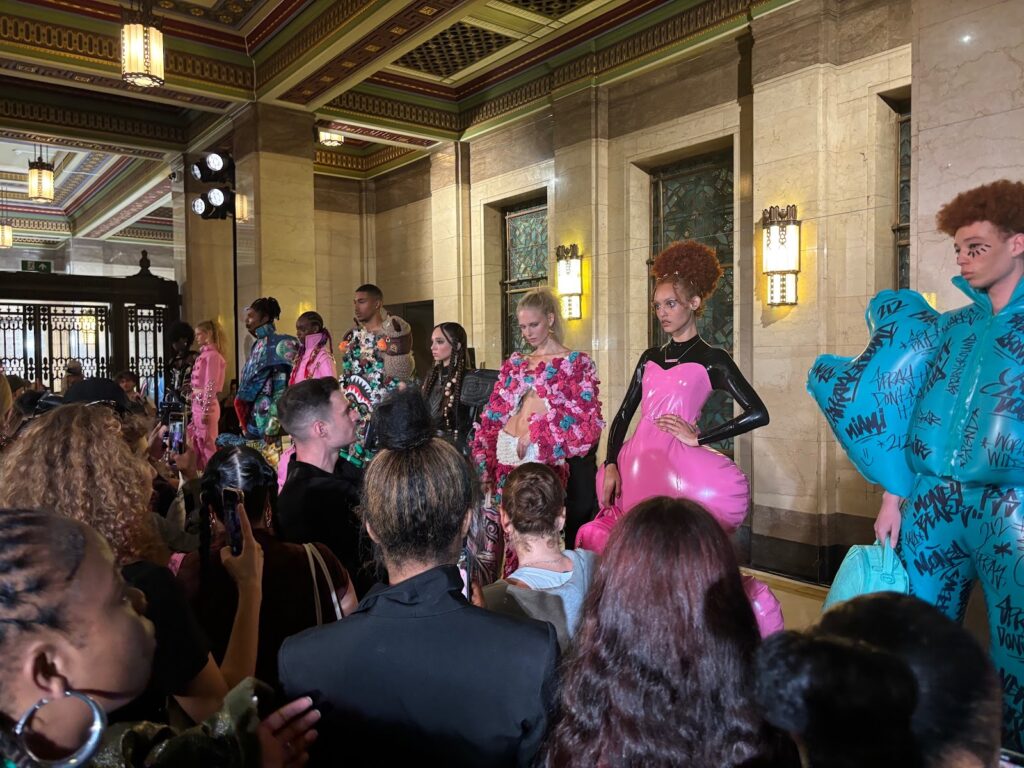
While mainstream coverage often focuses on broad trends, the most compelling work on the London schedule this season speaks to distinctive identities, sustainability and craft. From Afro-contemporary menswear to accessories rooted in artisanal techniques, the breadth of voices on offer suggests a fashion week less preoccupied with singular aesthetics and more invested in plural expression.
For students and young creatives, this edition of London Fashion Week is worth close attention – not for celebrity spectacle, but for how it frames fashion as a site of intellectual inquiry, where questions of materiality and community intersect on the runway.
In an industry often critiqued for its gatekeeping, this London Fashion Week feels less like an insider showcase and more like a living archive of what’s next – and who’s going to make it.






Leave a reply