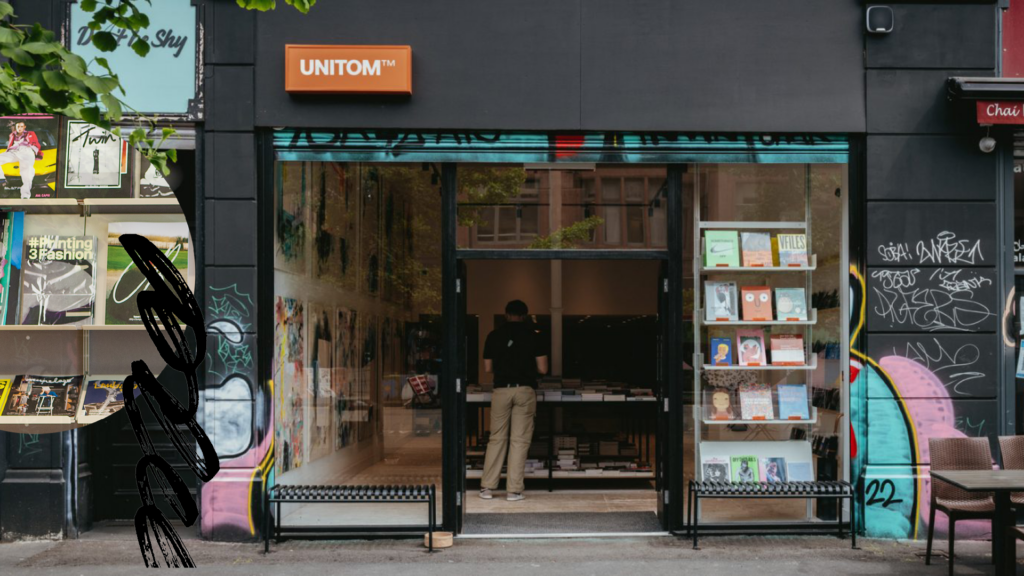
By Evie-Iris Atkins and Megan Levick. Featured image: UNITOM.
As part of our new series In Print: Celebrating Print Culture in Manchester, we speak to UNITOM head publishing buyer Tim Bell.
“Celebrating the worlds of visual culture” is what Northern Quarter magazine and bookshop UNITOM does best, says head publishing buyer Tim Bell. With an eclectic collection spanning over 400 variations of media, the independent store delivers endless inspiration to the city’s creatives, part of a growing community that values print culture in an increasingly digital world.
“It’s a niche community; everybody knows each other,” says Bell, highlighting how independent publications help create real connections, even in big cities where it’s easy to feel disconnected. UNITOM isn’t just a bookshop – it’s a creative space for independent publishing and collaboration. By not stocking commercial heavyweights like Vogue and Elle, UNITOM gives independent publications the room to make a real impact and cater to niche interests.
“Independent magazines have the most interesting things to say,” says Tim. “There are people doing very niche publications who have a genuine passion for that subject. More and more, we see magazines becoming more specialised. They’re produced and written by people for people who are also very knowledgeable and enthusiastic about that subject.”
UNITOM’s store layout is also reflective of this ethos. Expertly crafted to spark curiosity, its rough thematic structure encourages organic discovery. “UNITOM is roughly grouped because we see demographics of people shopping for a particular type of magazine,” Tim explains. “You might be buying a fashion magazine because you like a musician that’s being featured. All these creative practices fuse into one another – you’re not necessarily buying a fashion magazine just for the fashion content.”
As digital consumption overwhelms our generation, the desire for physical encounters is stronger than ever as people realise that social media is consuming our lives. According to media regulator OFCOM young people aged 18 to 24 in the UK spend an average of four hours and 36 minutes online each day. It’s a habit that’s increasingly shaping day-to-day life and behaviour. However, the overconsumption of algorithm-driven content, blinkered to narrow interests, is now being met with a growing craving for deeper, more meaningful experiences outside the digital realm. This shift is also seen in the resurgence of broader physical media – ‘zines, vinyl records, and even CDs – as people yearn for real-world connections that digital platforms can’t offer.
Tim is selective with what he exhibits. Whether it’s well-known names or smaller publications, physical media thrives in physical environments where people can feel inspired. “To present somebody who’s maybe publishing their first ‘zine alongside huge publications on equal footing… it benefits both,” he says. With nearly two decades of experience, Tim has cultivated a wide range of distributor relationships, crucial for sourcing publications: “I’ve been a buyer for nearly 20 years so I know quite a lot of people who are in the same space and we can feed back to each other. We can ask them to look for things that we’re finding difficult to bring in from abroad, for example.”
Acting as a portal for consumers, Tim’s observation of trending topics and visits to independent book fairs help him to accumulate a collection of diverse, compelling titles. UNITOM also offers a platform for local creators. At launch nights, people leave inspired to create their own publications: “We get people coming to the events, going on to do their own thing, and then we end up hosting them for an event,” Tim says. “We even see it amongst the staff too.”
One example is Dial In, a specialty coffee magazine created by UNITOM staff member and Manchester Met alumni Elliot Howard and co-founder and MA Multimedia Journalism graduate Ania Klekot. The magazine highlights independent coffee roasters and explores the craft, culture and community behind their work. Explaining the drive behind their magazine, Ania says: “We wanted to create a magazine that is niche. There was a gap in the market for something like this, and we both like coffee, so we wanted to collaborate on this together.”
In an era dominated by digital content, the duo are also dedicated to keeping print alive. “For us, it’s about trying to keep things in print; I’ve always wanted to do print. I’ve been a big fan of exhibitions all throughout my degree,” says Elliot. Before the magazine had even hit the shelves, Dial In had already caught the attention of a distributor – something Howard sees as “a testament to the enduring appeal of print”. Ania adds: “We want to prove that print is not dead. Every time I say that I’m writing a creative print magazine, everyone always says: ‘No-one buys print magazines anymore’, but it’s still very much alive, especially here in Manchester – there’s such a big scene for it.”
Tim echoes this: “I think there is a definite desire for people to push back against so much of their lives being digital. So much stuff that we do day-to-day has to be done by phone, or on a screen of some sort, and now there’s a backlash against that. People want to experience things more in the real [world].
“There’s a desire for people to be out there doing stuff in real-time,” he adds. “I think that ties into a print publication, especially the kind of stuff we do – more niche, more focused. There’s a general appetite in Manchester for people to feed off and be inspired by each other.”






Leave a reply