 By Joshua Lee
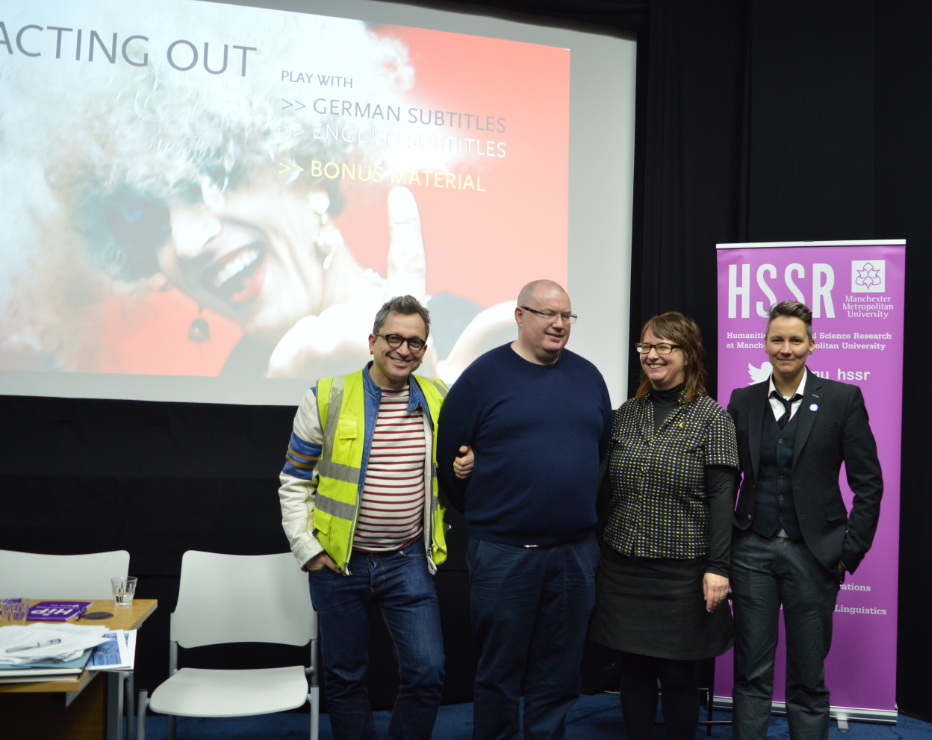
Becoming something of a harbinger for what is new and engaging in Manchester, Manchester Metropolitan University’s (Manchester Met) Number 70 building opened its doors last Friday for a screening of Acting Out: 25 years of Queer Film and Community in Hamburg. The event was hosted by the university’s Humanities in Public festival whose focus this term is ‘SEX’.
Organised by Manchester Met Senior Lecturer of Sociology Dr Christian Klesse and Dr Jon Binnie of the School of Science and Environment, the screening was part of a two day event called ‘Queer Film Festivals as Activism: An International Symposium.’ The symposium was an opportunity to bring together festival directors, programmers and academic researchers to discuss the importance of Queer film festivals in articulating what it means to be part of an LGBTQ community. The documentary shown was made as a celebration of the 25th anniversary of the Hamburg Queer Film Festival, Germany’s longest running LGBTQ film event.
Introducing the documentary, Christian Klesse talked about its producers, Germany’s Aye Aye Film, before going on to speak about the rising popularity of Queer film on an international scale. Since 1977, Queer film festivals have been gradually gaining wider audiences, which is a giant leap from forty years ago, when such festivals were limited to enjoyment by LGBTQ communities only. In the 20th century, the only directors who ever came close to bringing LGBTQ and Queer film into the mainstream media were the likes of Andy Warhol, John Waters, and Pier Paolo Pasolini, directors whose work was often considered outrageous and lacking in moral standards. Now, however, attitudes towards the LGBTQ community have changed, something that, via the use of archive footage dating back to 1989, the Acting Out documentary clearly shows in the dramatic development of the Queer film festival. The fact that the enjoyment of the Queer film festival is no longer restricted to LGBTQ people, but also open to people who may not identify themselves as such, is nothing short of a triumph for festival organisers.
The evolution of Queer film, as a medium, was something else the documentary explored. There was something pleasingly amateurish in the films screened during the early years of the festival, most having next to no budget and mainly narrating an exaggerated parody of the clichéd representation of LGBTQ people in mainstream films. Now, LGBTQ and Queer films are sought out across the globe and extensive research is done to ensure that only the best films are chosen for the festivals. One interviewee in the Acting Out documentary describes how Queer film festivals have “provided a platform for the community”, as there isn’t always “space” for LGBTQ issues in the mainstream media. The archive footage used in the film suggests that the Queer festival started out as a place where members of the LGBTQ community could meet and be open about themselves and their own experiences.
The documentary also explored the treatment of LGBTQ issues outside of the western world. For the majority of LGBTQ people in the western world there now exists a sense of liberation and safety to live openly, yet, in certain parts of the world, oppression is still rife. The ‘gay propaganda’ law in Russia, is just one example of such oppression, as are the laws on homosexuality in Cameroon, Central Africa, where a person engaging in same-sex relationships can expect up to 5 years imprisonment. When asked about this, in relation to the documentary, Christian Klesse responded, “Queer film provides a space not only to discuss local interpretations, but also to flag up the different experiences of other LGBTQ people in other parts of the world.”
Asked about what he hoped the audience would take away from the screening, Klesse answered, “A knowledge of the significance that Queer film, and Queer film festivals have in regard to sustaining a community for LGBTQ people – to highlight personal discoveries, and opportunities.”
Klesse and Jon Binnie have also jointly researched the geographies of LGBTQ activism throughout Europe and are currently researching the possibilities of cultural activism via Queer film festivals in various European cities.
To find out more about the upcoming events in the ‘SEX’ season, see the Humanities in Public webpage.


Leave a reply